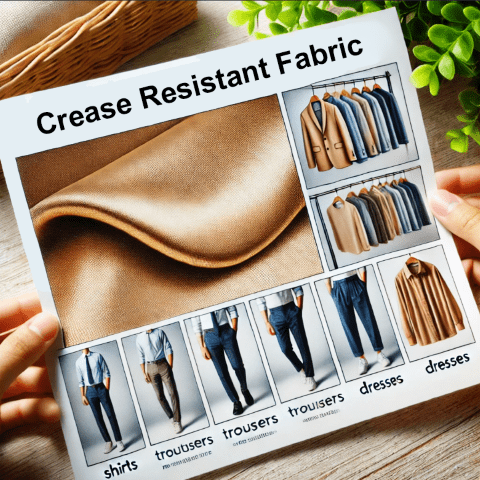
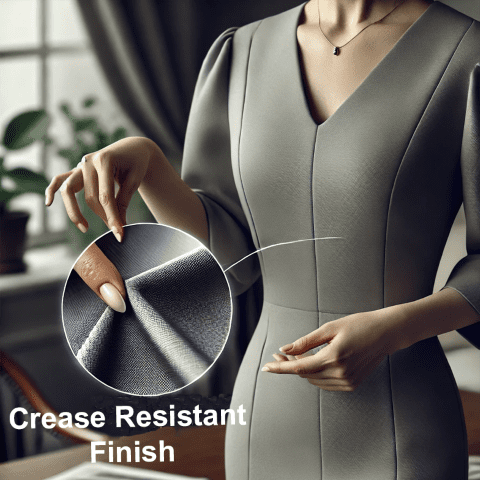
The crease resistant finish is a valuable innovation in the textile industry that imparts wrinkle resistance to fabrics, allowing them to maintain a smooth and crisp appearance even after prolonged use. In this article, we delve into the history, types, handling tips, major manufacturers, applications, and a compelling conclusion related to the crease resistant finish.
The need for crease resistant textiles emerged with the rise of modern living and the demand for garments and fabrics that could retain their shape and appearance. The development of crease resistant finishes can be attributed to ongoing research and technological advancements in textile chemistry and finishing processes.
Resin Finishes: These finishes involve the application of a resinous substance to the fabric, which forms a cross-linked network and provides wrinkle resistance.
Silicone Finishes: Silicone-based finishes create a protective coating on the fabric surface, enhancing its wrinkle resistance and durability.
Microencapsulation Finishes: In this type of finish, microcapsules containing wrinkle-resistant agents are embedded in the fabric, releasing the agents when subjected to pressure or heat.
Nano Finishes: Nano-sized particles are applied to the fabric, forming a thin film that reduces creasing and improves fabric resilience.
Permanent Press Finishes: These finishes involve a combination of resin and cross-linking agents that provide long-lasting crease resistance.
Follow Care Instructions: Always check the garment's care label for specific guidelines on washing, drying, and ironing crease resistant fabrics.
Gentle Washing: Use a gentle wash cycle and avoid harsh detergents that can degrade the crease resistant finish.
Hang or Fold Properly: Hang garments or fold them neatly to minimize the formation of creases when storing.
Ironing with Caution: If ironing is required, use a low to medium heat setting and iron on the reverse side or with a pressing cloth to prevent damage to the crease resistant finish.
Store Correctly: Store crease resistant fabrics in a cool, dry place away from direct sunlight to maintain their wrinkle-resistant properties.
W.L. Gore & Associates - Known for their innovative fabric technologies, W.L. Gore & Associates offers crease resistant finishes for various industries including outdoor apparel and performance textiles.
Archroma - A global leader in specialty chemicals, Archroma provides crease resistant solutions for textiles, ensuring wrinkle-free and durable fabrics.
Huntsman Textile Effects - Huntsman Textile Effects offers a range of crease resistant finishes that provide excellent wrinkle resistance and garment longevity.
Clariant - Clariant is a leading provider of specialty chemicals, including crease resistant finishes, which contribute to wrinkle-free textiles in various applications.
Milliken & Company - Milliken & Company is a renowned manufacturer of performance textiles, offering crease resistant finishes that enhance the functionality and appearance of fabrics.
Apparel: Crease resistant finishes are widely used in the production of wrinkle-free garments, including dress shirts, trousers, skirts, and blouses, ensuring a crisp and professional look.
Home Textiles: Crease resistant finishes find applications in bedding, table linens, curtains, and upholstery fabrics, providing convenience and maintaining a neat appearance.
Travel and Outdoor Gear: Crease resistant finishes are valuable in travel and outdoor gear such as jackets, pants, and backpacks, allowing users to maintain a fresh and wrinkle-free look during their adventures.
Workwear and Uniforms: Crease resistant fabrics are highly desirable for workwear and uniforms, ensuring a polished appearance throughout the day without the need for frequent ironing.
Automotive Interiors: Crease resistant finishes are utilized in automotive textiles, including seat covers and interior trims, providing resistance to creasing and enhancing the aesthetics of the vehicle.
The crease resistant finish has revolutionized the textile industry by offering fabrics that maintain their smooth and wrinkle-free appearance. With various types of finishes available and careful handling, crease resistant fabrics can provide long-lasting convenience and elegance in numerous applications. Manufacturers such as W.L. Gore & Associates, Archroma, Huntsman Textile Effects, Clariant, and Milliken & Company have played a significant role in advancing the development and application of crease resistant finishes. Whether it's in apparel, home textiles, travel gear, workwear, or automotive interiors, crease resistant fabrics have become an essential choice for those seeking both style and convenience.
Additional definition by Sanya Malhotra
Crease-Resist Finish
A crease resist finish is a chemical treatment applied to fabrics that helps prevent creasing and wrinkling. The finish is designed to create a smoother, more wrinkle-free fabric, which can be particularly useful for clothing and home textiles.
Crease resist finishes are often applied to fabrics made from natural fibers, such as cotton or linen, which are more prone to wrinkling than synthetic fibers. The finish is applied after the fabric has been woven or knitted, and can be achieved through a variety of methods, including resin finishing or heat-setting.
Resin finishing involves applying a resin to the fabric, which creates a hard, protective layer on the surface of the fabric. This layer helps prevent creasing and wrinkling, while also improving the fabric's durability and resistance to wear and tear. Resin finishing can be achieved through a variety of methods, including pad-dry-cure, spray, and foam application.
Heat-setting involves applying heat to the fabric, which helps to set the fibers and prevent creasing and wrinkling. This method is often used for synthetic fibers, such as polyester or nylon, but can also be used for natural fibers. The heat sets the fibers in place, creating a smoother, more wrinkle-free surface.
Crease resist finishes are used in a variety of applications, including clothing, home textiles, and upholstery. Clothing manufacturers often use crease resist finishes for dress shirts, blouses, and other garments that require a smooth, wrinkle-free appearance. Home textile manufacturers use crease resist finishes for curtains, drapes, and bedding, where a smooth appearance is desired. Upholstery manufacturers also use crease resist finishes for furniture fabrics, where a wrinkle-free appearance is important for maintaining the appearance of the furniture.
Top manufacturers of crease resist finishes include companies such as BASF, Dow Chemical, and Huntsman. These companies offer a range of chemical treatments designed to improve the crease resist properties of fabrics. They also provide testing and analysis services to ensure that fabrics meet desired crease resist standards.
There are several methods used to measure the crease resist properties of fabrics, including the wrinkle recovery angle test and the crease recovery angle test. The wrinkle recovery angle test measures the ability of a fabric to recover from a wrinkled state, while the crease recovery angle test measures the ability of a fabric to recover from a creased state. These tests help manufacturers determine the effectiveness of crease resist finishes and ensure that fabrics meet desired standards.
In conclusion, crease resist finishes are a chemical treatment applied to fabrics that helps prevent creasing and wrinkling. The finish is designed to create a smoother, more wrinkle-free fabric, which can be particularly useful for clothing and home textiles. Crease resist finishes are often applied to fabrics made from natural fibers, such as cotton or linen, which are more prone to wrinkling than synthetic fibers. Top users of crease resist finishes include clothing manufacturers, home textile manufacturers, and upholstery manufacturers. Top manufacturers of crease resist finishes include companies such as BASF, Dow Chemical, and Huntsman. There are several methods used to measure the crease resist properties of fabrics, including the wrinkle recovery angle test and the crease recovery angle test.
Note: This content is for informational purposes only. Please read our full disclaimer for more details.
Surah is a type of fabric that is commonly used in the production of formal and semi-formal clothing. It is a lightweight and lustrous fabric that has a smooth texture and a silky finish. The name...
The Annure motif is a decorative pattern commonly found in textile design. The motif consists of a series of interconnected circles, often with a central dot or flower-like shape, creating a lacy,...
Decitex Secrets: How It Defines Textile Strength and Texture In the textile industry, Decitex (dtex) is a unit of measurement used to determine the linear density or fineness of fibers or yarns. It...
In the realm of textiles, embroidery refers to the artful technique of embellishing fabric using needle and thread. It involves creating intricate designs, patterns, or images by stitching thread...

 Share on X