Share on X
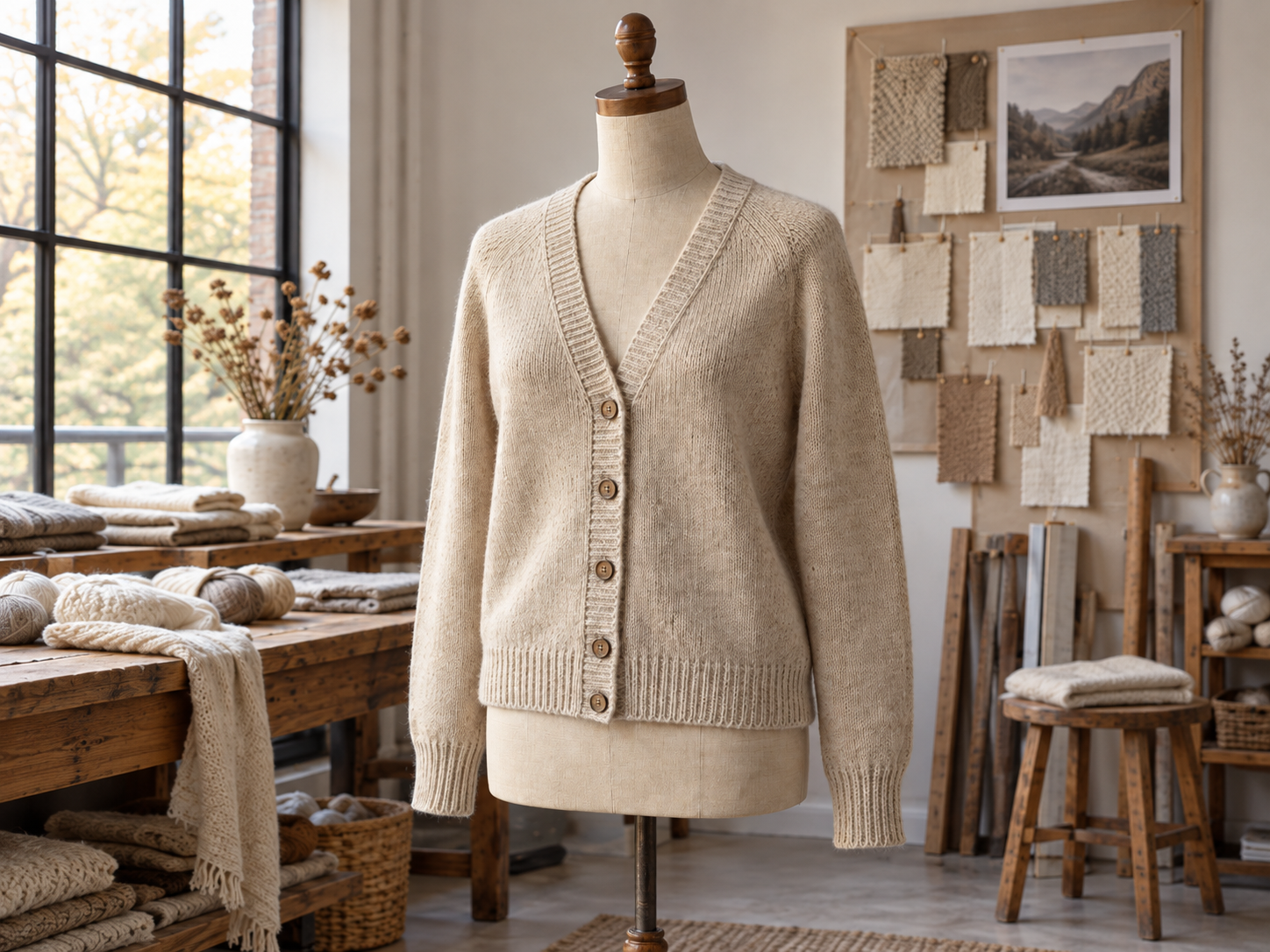
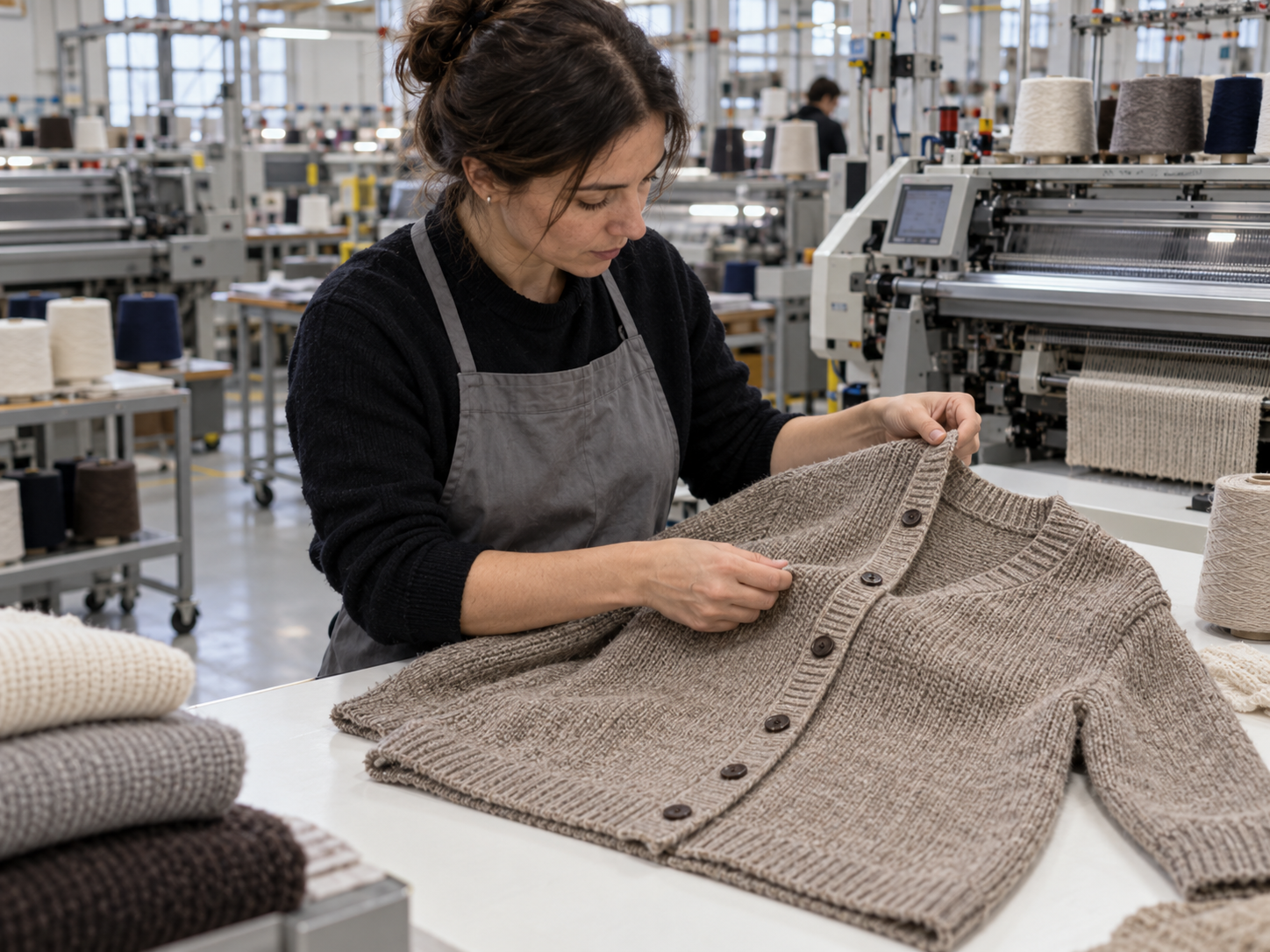
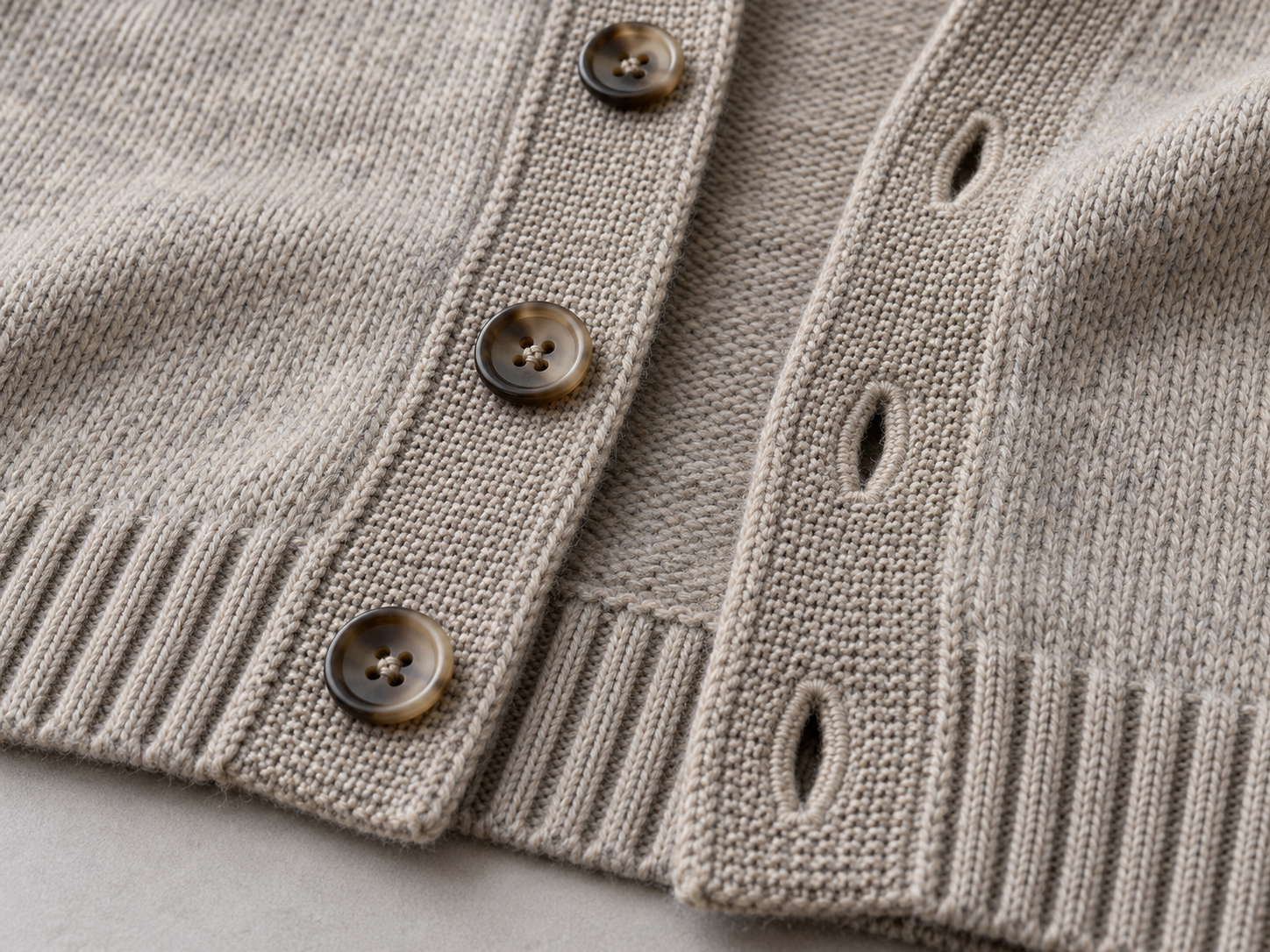
A cardigan is a knitted upper-body garment distinguished by an opening at the front, commonly secured with buttons, a zipper, ties or other fastenings, although some designs are intended to remain open. Unlike a conventional pullover sweater, a cardigan can be put on or removed without passing the garment over the head. This apparently simple distinction has important consequences for textile construction, garment engineering, comfort, production and everyday use.
Cardigans occupy an unusually broad position within knitwear. They range from fine-gauge garments suitable for office wear to heavy, textured wool garments designed for cold conditions. Their performance depends on the interaction of fibre selection, yarn construction, knitted loop geometry, garment shaping, fastening systems and finishing. The front opening introduces additional engineering requirements: the edges must resist distortion, the closure must remain aligned, and the garment must retain its intended shape during repeated wearing and laundering.
For textile students, manufacturers and apparel professionals, the cardigan provides a useful example of how knitted fabric properties translate into garment performance. Its evolution also illustrates the relationship between functional clothing, industrial knitting technology and changing social expectations of dress. Understanding the cardigan requires examining not merely its appearance but how its materials, structure and production determine warmth, flexibility, durability, maintenance and useful life.
What Defines a Cardigan in Textile Terminology?
In contemporary textile and apparel terminology, a cardigan is generally understood as a front-opening knitted sweater or sweater-like garment. Its defining characteristic is the front opening rather than a particular fibre, knitting pattern, neckline, gender association or fastening material.
A traditional cardigan has two front panels, a back, sleeves and a neck opening. Buttons and corresponding buttonholes are common, but zippered, belted, tie-front and fastening-free designs also fall within modern commercial usage. Most cardigans have long sleeves, although sleeveless and short-sleeved variations exist.
The relationship between a cardigan and a sweater is hierarchical: a cardigan is a type of sweater, whereas not every sweater is a cardigan. In British English, jumper frequently denotes a pullover knitted garment. In American English, sweater is the broader everyday term. Regional naming conventions therefore affect retail descriptions but do not fundamentally change the construction of a cardigan.
The word cardigan can also refer to a soft, open-front garment made from knitted yardage rather than shaped sweater panels. Such garments may have a looser, more jacket-like silhouette. Nevertheless, a woven tailored jacket is not technically equivalent to a knitted cardigan merely because both have front openings. A useful classification considers the actual fabric construction, intended fit and garment assembly rather than relying exclusively on merchandising terminology.
Historical Origins and Evolution of the Cardigan
The name cardigan is traditionally associated with James Brudenell, the seventh Earl of Cardigan, a British army officer remembered for his role in the Crimean War. The connection between the garment name and the title is well established in conventional clothing histories, but popular accounts that attribute the precise invention of the modern cardigan to one individual should be treated cautiously. Front-opening knitted clothing developed within a broader history of wool garments, military dress and practical layering.
By the late nineteenth and early twentieth centuries, cardigan sweaters had become identifiable clothing categories. A wool cardigan dated 1900–1903 in the Metropolitan Museum of Art's collection demonstrates that the recognizable garment was established by the beginning of the twentieth century. Another American cardigan in the museum's collection, dated approximately 1918, incorporates silk and wool.
During the twentieth century, cardigans moved beyond their associations with warmth and practical informal clothing. They became components of coordinated knitwear ensembles, sportswear, professional dress and luxury fashion. The matching cardigan-and-pullover combination, often called a sweater set or twinset, became a particularly recognizable form of coordinated dressing.
Museum collections illustrate the garment's adaptability. A 1968 cardigan by Cacharel demonstrates its presence in French ready-to-wear design. A 1974 cardigan associated with Chanel uses wool and angora. A circa-1975 evening ensemble by Halston employs a full-length cardigan with a dress, illustrating how knitwear could enter sophisticated evening dressing. These examples demonstrate stylistic development without implying that any single designer originated the cardigan itself.
Cardigan Fibres, Yarns and Material Selection
Cardigan performance begins with fibre selection. Although wool remains strongly associated with traditional cardigans, contemporary garments use cotton, regenerated cellulosic fibres, synthetic fibres and numerous blends. Fibre identity alone does not determine quality; yarn structure, fabric density, finishing and workmanship are equally important.
Wool: Wool fibres have natural crimp and resilience, properties that support air retention within knitted structures and contribute to thermal comfort. Merino wool is frequently selected for finer knitwear. Wool garments can, however, be vulnerable to felting shrinkage under unsuitable laundering conditions, depending on fibre treatment and fabric construction.
Cashmere: Fine cashmere fibres are used in lightweight, soft cardigans where tactile comfort is a priority. Fibre quality, yarn twist, knitting density and finishing influence appearance and pilling behaviour. A cashmere label alone is not evidence of exceptional durability.
Cotton: Cotton offers moisture absorbency and a familiar surface feel. Cotton cardigans are useful for transitional weather and indoor environments, although comparatively heavy cotton constructions may stretch or sag if insufficiently stabilized.
Regenerated cellulosic fibres: Viscose, modal and lyocell may be selected for fluid drape, softness and blended-yarn applications. Dimensional stability and wet handling depend on the specific fibre and knitted construction.
Synthetic fibres: Polyester, acrylic, nylon and elastane serve different functions. Acrylic can provide lightweight bulk; nylon may improve resistance to certain mechanical stresses; elastane can support recovery where deliberately incorporated. Synthetic fibres do not automatically improve every property, and some constructions may retain pills or present end-of-life recycling difficulties.
Yarn count, twist, ply, hairiness and consistency influence fabric appearance and serviceability. A loosely spun, highly hairy yarn may create a desirable soft surface but can also show greater surface fuzzing under abrasion. Fibre and yarn specifications should therefore be matched to the intended cardigan rather than selected solely for marketing appeal.
Knitted Structures and Their Effect on Cardigan Performance
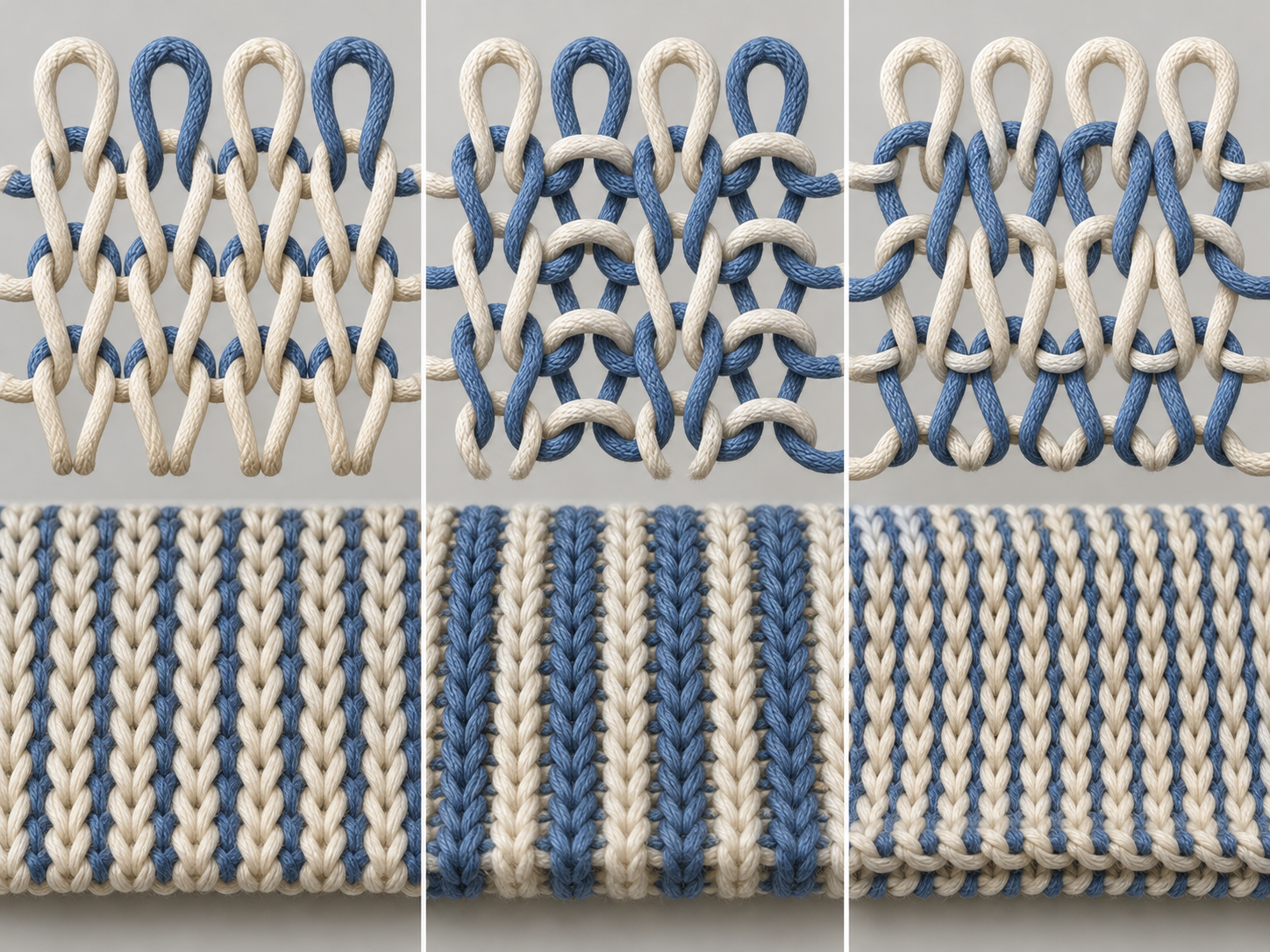
Most conventional cardigans depend on weft-knitted structures, in which yarn forms interconnected loops across successive courses. A course is a predominantly horizontal row of loops; a wale is a predominantly vertical column. Loop geometry gives knitted fabrics their characteristic extensibility and distinguishes their mechanical behaviour from most ordinary woven fabrics.
Single jersey: This structure produces relatively smooth face stitches and a different reverse appearance. Its simplicity supports lightweight garments, but unsupported edges may curl. Edge finishing is therefore particularly important around cardigan openings.
Rib knitting: Alternating knit and purl wales produce extensible fabrics commonly used for cuffs, waistbands, neckbands and front bands. CottonWorks explains that rib construction can offer substantial widthwise stretch and that its structure differs from single jersey in edge-curling behaviour. Rib patterns such as 1 × 1 and 2 × 2 offer different visual proportions and fabric responses.
Interlock: Interlock structures can produce smooth, relatively stable double-knit fabrics suitable for certain refined cardigan constructions. Their behaviour differs from both single jersey and conventional rib fabrics.
Cable and textured knitting: Transferred stitches, purl arrangements and raised patterns provide surface relief. These effects can increase thickness and change the way the garment hangs, but they do not guarantee superior insulation or durability.
Knitting gauge describes machine needle density or, in another context, measured stitch density. The two should not be confused. Fine-gauge fabrics often suit streamlined layering, whereas coarser constructions can accommodate larger yarns and more prominent textures. Thermal performance ultimately depends on fibre, structure, thickness, fit and environmental conditions rather than gauge alone.
How Cardigans Are Manufactured
Industrial cardigan production combines garment design, yarn engineering, knitting, assembly, finishing and quality assurance. Manufacturers choose between several construction approaches according to intended appearance, machinery, production scale and cost.
- Design and specification: A technical specification establishes measurements, silhouette, stitch structures, yarn requirements, closure placement, tolerances and finishing instructions.
- Yarn sourcing and preparation: Appropriate yarn counts, colours and fibre compositions are selected and checked for consistency. Where necessary, yarns are conditioned or prepared for knitting.
- Panel knitting: Front panels, back panels and sleeves may be knitted separately. Fully fashioned methods use controlled increases and decreases to form shaped components, potentially reducing cutting waste.
- Alternative knitting routes: Cut-and-sew production uses knitted fabric pieces cut to pattern. Seamless or near-seamless whole-garment knitting forms much of the garment directly on specialized equipment.
- Assembly: Separately produced components are joined through linking, sewing or other suitable seam constructions. Accurate assembly helps preserve symmetry and intended dimensions.
- Closure and trim attachment: Button bands, buttonholes, zippers, pockets, labels and decorative elements are added or completed as required.
- Finishing and inspection: Washing, controlled relaxation, steaming, pressing or other finishing processes establish the specified appearance and dimensions before final inspection.
The front opening deserves special attention. If the knitted fabric is highly extensible, a poorly engineered button band may elongate, ripple or pull away from the body. The manufacturer must control band structure, stitch density, closure spacing and any necessary reinforcement. Production efficiency therefore depends not only on knitting speed but also on minimizing distortion, rework and rejection during assembly and finishing.
Major Types and Design Variations of Cardigans
Cardigans are classified by silhouette, length, closure and knitted structure. These classifications overlap: a cropped cardigan can be cable-knitted, and a long cardigan may use either buttons or an open front.
| Type | Identifying feature | Typical design consideration |
|---|---|---|
| Classic button-front | Full front opening with buttons | Band stability and closure alignment |
| V-neck | Neckline slopes toward the opening | Neckband shaping and reinforcement |
| Shawl-collar | Broad collar rolls around the neckline | Collar weight, drape and seam support |
| Chunky or cable-knit | Large yarns or prominent texture | Bulk, mass and dimensional recovery |
| Longline | Extended body length | Vertical growth and hem stability |
| Cropped | Shortened body ending higher on the torso | Proportion and waistband behaviour |
| Open-front | No required fastening | Front-edge drape and balance |
| Zip-front | Zipper secured along the opening | Compatibility of zipper length and fabric stretch |
The distinctions between a cardigan, a shrug and a bolero can be less precise in commercial styling. A shrug usually provides abbreviated coverage and may have little front-body structure. A cardigan generally has more recognizable sweater panels and a continuous front opening. A cardigan-style jacket may borrow collar, pocket or trim details from tailored outerwear while retaining knitted construction.
In textile product development, the relevant question is not simply what the design is called but whether its construction delivers the intended fit, appearance, movement and maintenance performance.
Fit, Comfort and Functional Garment Engineering
Cardigan fit is governed by body measurements, garment ease, fabric extensibility and the intended layering system. Ease refers to the difference between a garment's dimensions and the corresponding body measurements. Positive ease supports movement and layering, while close-fitting designs rely more heavily on the knitted fabric's ability to stretch and recover.
Important measurement points include chest circumference, body length, shoulder width, armhole depth, sleeve length and hem opening. Sleeve design influences mobility, while shoulder placement affects how the garment's weight is distributed.
A front-opening garment must also maintain balance when worn unfastened. Excessive front-panel weight can encourage the opening to spread or pull downward. Heavy pockets may distort a loosely knitted body, particularly if the pocket openings are inadequately stabilized.
Thermal comfort depends partly on the air retained within the fabric and between clothing layers. An open cardigan allows ventilation and can be adjusted quickly when moving between indoor and outdoor environments. It is not inherently windproof, however, and a loosely knitted construction may admit substantial airflow.
Comfort also involves tactile and physiological responses. Fibre coarseness, seam bulk, labels and collar construction affect skin sensation. Moisture movement and drying behaviour vary across fibres and knitted structures. Consequently, a well-designed cardigan balances warmth, breathability, mobility, skin comfort and the practical demands of repeated wear.
Quality Assessment, Defects and Production Testing
Cardigan quality cannot be established by appearance or fibre label alone. A structured evaluation examines raw materials, knitting consistency, construction, dimensional behaviour and performance during use.
Common inspection concerns include irregular stitch size, dropped stitches, holes, yarn contamination, shade variation, distorted seams, twisted sleeves and misaligned front panels. Closure performance is particularly important. Buttons should be securely attached, buttonholes should accommodate the intended buttons without excessive force, and zipper installations should not create pronounced rippling.
Dimensional stability is assessed by comparing garment measurements before and after specified care procedures. Shrinkage, growth, twisting and changes in shape can indicate unsuitable material combinations or insufficient production control. Test procedures must match the fibre composition, finish and intended care instructions.
Pilling assessment examines the formation of entangled fibre clusters through wear or controlled abrasion. Pilling can occur in both natural and synthetic materials; its severity depends on fibre properties, yarn construction, fabric structure and exposure conditions.
Additional evaluations may address colourfastness, seam strength, bursting resistance, surface abrasion and fastening durability. These properties require appropriate established test methods and agreed acceptance criteria. No universal numerical pass threshold applies to every cardigan construction.
For procurement, a useful technical specification defines the garment's intended use, measurable requirements, approved test procedures and inspection tolerances. Consistent factory measurements and representative laundering trials are generally more informative than unsupported descriptions such as premium quality or exceptionally durable.
Care, Washing, Drying and Storage of Cardigans
Care requirements depend on fibre content, yarn structure, dyes, finishes, trims and garment construction. The sewn-in care label should take precedence over generic advice, particularly for garments containing delicate fibres, decorative finishes or specialized treatments.
Woolmark recommends checking the care instructions before laundering wool knitwear. Machine-washable wool garments may be washed using an appropriate wool cycle and detergent when their labels permit it. Other garments may require careful hand washing or professional cleaning. Excessive agitation, unsuitable temperatures and incorrect detergents can damage susceptible wool constructions.
Drying deserves particular attention. Wet knitted fabric can elongate under its own weight, especially when suspended from a hanger. Woolmark recommends drying sweaters flat unless their care instructions specifically permit another method. Reshaping the garment while damp helps preserve the intended dimensions.
For ordinary cardigan maintenance, practical precautions include:
- Fasten buttons or zippers before storage or washing where appropriate, avoiding excessive tension on the front panels.
- Separate garments by colour and follow fibre-specific washing instructions.
- Avoid wringing delicate knitwear or exposing it to unnecessary heat.
- Fold susceptible knitted garments rather than leaving them suspended for long periods.
- Remove pills carefully using a suitable tool without cutting structural yarn loops.
- Repair loose buttons, minor seam failures and small holes before damage spreads.
Clean, dry storage also helps protect susceptible animal-fibre garments from insect damage. Woolmark advises cleaning wool garments before long-term storage because food residues and body oils can attract moths.
Correct care does more than preserve appearance. By reducing avoidable shrinkage, distortion and mechanical damage, it can extend useful garment life and reduce the frequency of replacement.
Sustainability, Durability and Circular Knitwear Design
The environmental consequences of a cardigan depend on its complete material and product system. Fibre cultivation or production, yarn manufacture, knitting, dyeing, finishing, transport, laundering and eventual disposal can all contribute to environmental impacts. There is no universally sustainable cardigan fibre independent of sourcing, production methods and expected lifetime.
Animal fibres such as wool are renewable but have impacts associated with livestock production, land management and processing. Cotton production involves agricultural inputs that vary greatly by location and cultivation method. Synthetic fibres originate principally from industrial polymer production, and some can release persistent microplastic fibres during laundering. Regenerated cellulosic fibres require evaluation of feedstock sourcing and chemical processing rather than assumptions based solely on their plant-derived origin.
Durability and repairability are central considerations. Well-supported button bands, replaceable buttons, accessible seams and stable knitted structures can make a cardigan easier to maintain. A high-quality repair may restore serviceability without requiring an entirely new garment.
Fully fashioned and whole-garment knitting can reduce certain forms of cutting waste compared with conventional cut-and-sew manufacturing. Actual environmental benefits depend on yarn utilization, machine efficiency, production energy, rejected products and other factors.
Blended fibres may improve specific performance characteristics but can complicate textile-to-textile recycling. Recyclability therefore requires examination of actual fibre composition and available processing infrastructure.
A credible circular-design approach prioritizes appropriate material selection, dependable construction, realistic care instructions, repair options and extended use. Sustainability should be assessed through documented product characteristics rather than broad claims attached to a particular fibre or knitting technology.
Cardigans in Textile Industry, Fashion and Museum Collections
The cardigan has maintained its commercial relevance because the underlying garment format can accommodate substantially different textiles, price points and wearing contexts. Industry activity spans yarn suppliers, knitting manufacturers, apparel design houses, technical development teams and retailers.
Cacharel: The Metropolitan Museum of Art documents a French cardigan sweater designed by Jean Bousquet for Cacharel in 1968. The wool garment provides a documented example of cardigan development within modern ready-to-wear fashion.
Chanel: The museum also holds a 1974 cardigan sweater from the House of Chanel made with wool and angora. The surviving object illustrates the role of fibre selection and knitwear design within luxury apparel.
Halston: A circa-1975 evening ensemble in the Metropolitan Museum's collection features a full-length cashmere cardigan, showing how the garment moved beyond everyday outer layering into refined coordinated dressing.
Yves Saint Laurent: A 1972–1973 evening ensemble in the same collection references a patterned cardigan through embroidery and decorative construction. The museum identifies it as a visual interpretation rather than an ordinary knitted sweater, an important distinction between textile construction and design imitation.
The Metropolitan Museum of Art: Its Costume Institute preserves cardigan examples from different periods, designers and material traditions, providing material evidence for the garment's development.
CottonWorks: This textile education resource explains knitted structures, including rib construction relevant to cardigan cuffs, bands and other components.
The Woolmark Company: Woolmark provides technical and consumer guidance on wool garment maintenance, including washing, drying, storage and repair.
These documented connections illustrate distinct roles in cardigan design, preservation, material education and care. They should not be interpreted as a ranking of current cardigan manufacturers or as evidence that any organization produces a particular garment today.
Modern Cardigan Development and Future Technical Priorities
Contemporary cardigan development combines established knitting principles with computerized design, programmable flat-knitting machines, digital pattern grading and improved production monitoring. Designers can coordinate stitch structures, shaping and garment dimensions more precisely through digital development workflows.
Whole-garment knitting is particularly relevant because it can integrate garment shaping into the knitting operation and eliminate some conventional assembly stages. However, specialized equipment does not automatically produce a better cardigan. Machine capability, yarn compatibility, production efficiency, appearance and repair requirements remain important.
Another development priority is stable performance across repeated use. Improved control of stitch density, yarn selection, finishing and closure construction can reduce dimensional change and deformation. Such improvements may offer greater practical value than superficial design novelty.
Material innovation also creates opportunities and challenges. Recycled yarns, traceable fibre supply chains and alternative fibre blends require evaluation of consistency, mechanical performance, processing compatibility and genuine environmental benefit.
For textile professionals, the most productive direction is an integrated approach: design the cardigan for a defined user, select appropriate materials, verify real performance and consider how the garment can be maintained or repaired. Digital knitting technology and sustainability strategies become meaningful when they support these measurable outcomes.
Why Cardigan Construction and Material Quality Still Matter
The cardigan demonstrates how a familiar garment can embody sophisticated textile engineering. Its essential front-opening form creates both practical advantages and structural demands. The knitted body must provide appropriate extensibility and comfort, while bands, closures, seams and supporting components maintain the garment's shape. Fibre selection influences the experience of warmth, softness and moisture management, but the final result depends on how the yarn and knitted structure function together.
Historical examples show that the cardigan has never belonged exclusively to one style, social group or level of formality. From early wool knitwear to twentieth-century designer ensembles, its construction has supported practical clothing as well as sophisticated design. This versatility continues in lightweight office garments, casual cotton knitwear, chunky wool styles and specialized contemporary silhouettes. For manufacturers and buyers, careful assessment of stitch consistency, dimensional stability, fastening performance and care requirements provides a better basis for judging quality than appearance or fibre branding alone.
The future relevance of cardigans rests partly on their adaptability to changing expectations of comfort, durability and responsible production. Computerized shaping, carefully selected yarn systems, repairable components and evidence-based material decisions offer opportunities to improve performance while reducing avoidable waste. A well-designed cardigan is therefore more than a convenient layering garment: it is a practical demonstration of how fibre science, knitted structure, manufacturing accuracy and long-term care can combine to create lasting textile value.