Share on X
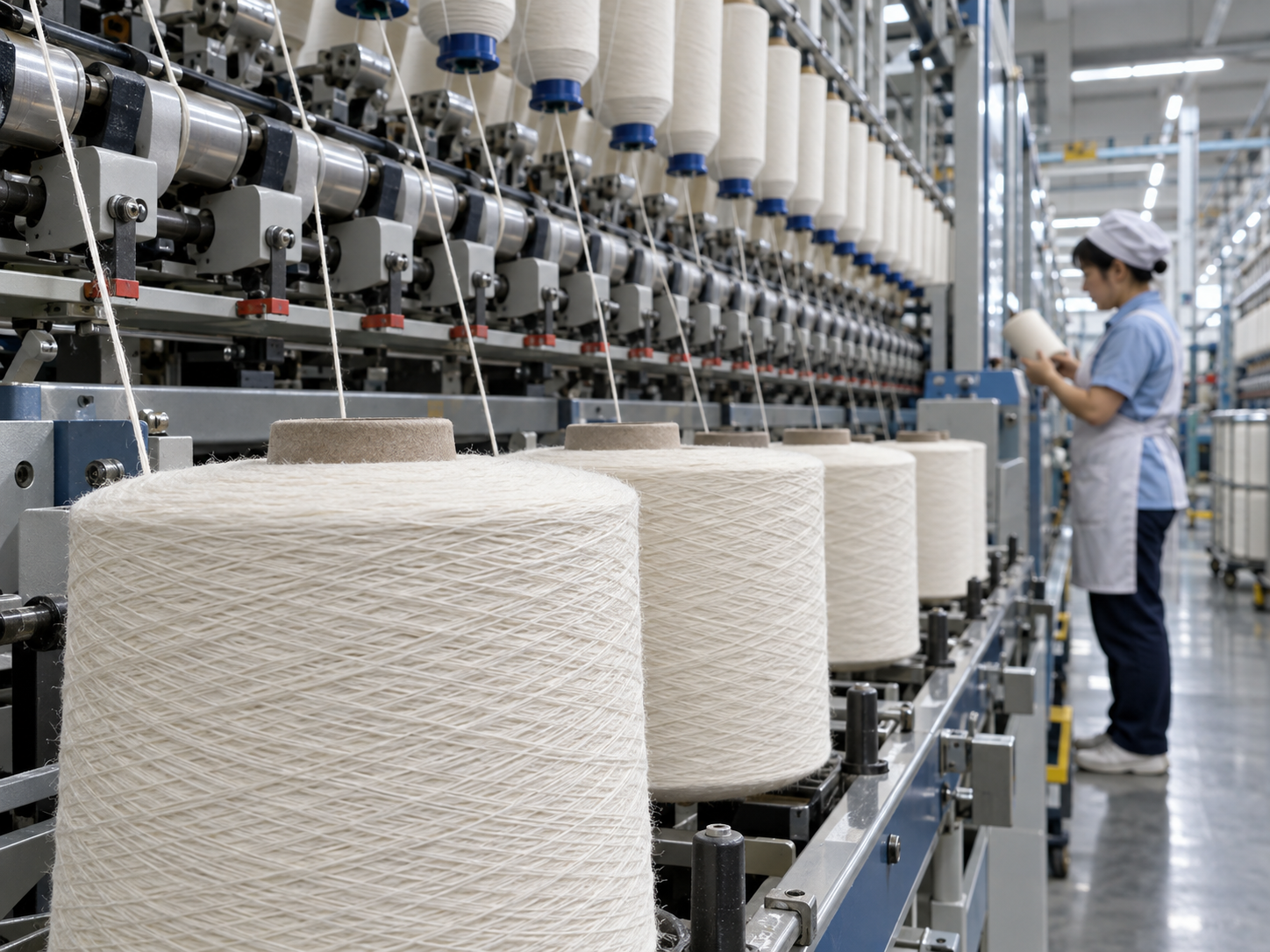
Spun yarn is a fundamental textile material made by assembling relatively short fibers, known as staple fibers, into a continuous strand with sufficient cohesion for subsequent processing. Cotton and wool are naturally available as staple fibers, while manufactured fibers such as polyester, viscose and acrylic can be cut to staple lengths and processed through comparable spinning systems. The resulting yarn differs structurally from continuous-filament yarn: instead of one or more essentially continuous filaments extending through the package, a spun yarn contains many overlapping fiber lengths held together by twist, wrapping, entanglement or combinations of these mechanisms.
The choice of fiber, preparation route and spinning technology strongly influences yarn strength, evenness, hairiness, bulk, handle, appearance and processing behavior. Ring, compact, rotor and air-jet systems therefore do more than provide alternative ways of manufacturing the same product; each creates a characteristic fiber arrangement and economic balance. Understanding spun yarn requires examining the complete relationship between staple-fiber preparation, drafting, yarn formation, twist, yarn count, quality testing and intended fabric application. Pasted text
What Spun Yarn Means in Textile Technology
A spun yarn is a yarn formed primarily from staple fibers rather than continuous filaments. A large number of individual fibers overlap along the yarn length, and the spinning process creates enough cohesion for the strand to withstand handling, winding and fabric production. In conventional ring spinning, this cohesion is produced principally by twist. Rotor and air-jet technologies arrange and bind fibers differently, but their products are still classified as staple-fiber or spun yarns.
The word spun can cause confusion because textile manufacturing uses the term spinning in several different contexts. Staple-yarn spinning means converting discrete fibers into yarn. Polymer spinning, by contrast, refers to forming manufactured filaments by processes such as melt, wet or dry spinning. A polyester filament emerging from a spinneret is therefore manufactured by a spinning process but is not necessarily a spun yarn in the staple-yarn sense. If polyester filaments are subsequently cut into staple fibers and those fibers are assembled into yarn, the resulting product is spun polyester yarn.
Spun yarn should also be distinguished from plied yarn. A spun yarn may be a single yarn or may subsequently be combined with other singles through plying. Terms such as ring-spun, rotor-spun and air-jet-spun identify the yarn-forming system, whereas terms such as two-ply describe a later structural arrangement.
Staple Fibers and the Basis of Spun-Yarn Structure
The behavior of spun yarn begins with the dimensions and properties of its constituent fibers. Fiber length determines how extensively neighboring fibers can overlap. Fineness affects the number of fibers that can occupy a given yarn cross-section, while strength, elongation, surface friction, crimp, maturity and uniformity can influence both spinning performance and yarn properties.
Natural staple fibers include cotton and wool. Manufactured fibers such as polyester, viscose and acrylic can be produced or converted into staple form in lengths selected for particular spinning systems. Blending makes it possible to combine fibers before yarn formation, producing structures in which the properties of two or more fiber types contribute to the resulting yarn.
Individual staple fibers do not normally extend for the full yarn length. Instead, thousands of overlapping fibers create continuity collectively. In a twist-based yarn, fibers follow generally helical paths around the yarn axis. Friction and pressure between neighboring fibers resist their sliding apart when the yarn is loaded. Greater twist can therefore increase cohesion up to an application-dependent range, although excessive twist may make a yarn harder, denser or less suitable for the desired fabric character. Fiber alignment, migration and the degree to which fiber ends protrude from the yarn surface also influence strength, hairiness and handle.
From Loose Fiber to a Continuous Yarn
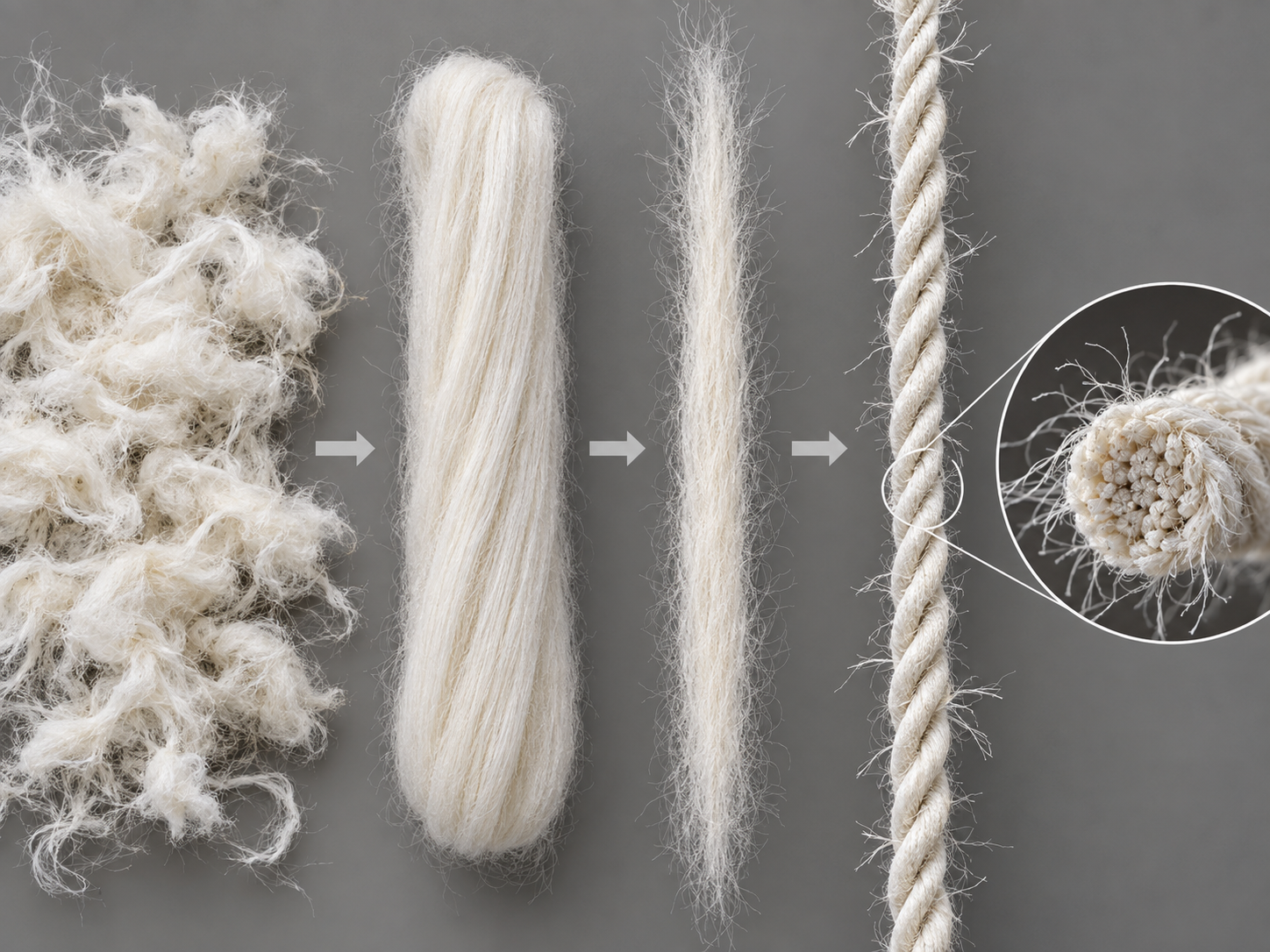
Staple-yarn manufacture is a sequence of preparation and yarn-forming operations rather than a single spinning action. The exact route depends on the fiber and spinning system, but short-staple processing commonly begins by opening compacted fiber masses, removing contaminants where necessary and blending the material. Carding separates and individualizes fibers while forming them into a continuous sliver. Drawing combines and drafts slivers to improve regularity and fiber alignment.
Additional preparation may be used when the required yarn quality justifies it. Cotton intended for combed yarn, for example, undergoes combing to remove a proportion of short fibers and improve parallelization. Ring spinning generally uses roving as an intermediate package: drawn material is attenuated and given enough cohesion to permit handling before final drafting. Rotor and some other newer systems can eliminate this roving stage and feed sliver more directly.
The final spinning stage must reduce the fiber strand to the required linear density and create a stable yarn structure. The yarn is then wound into a package appropriate for storage, transport or downstream operations. Ring-spun bobbins typically require a subsequent winding operation to produce larger packages suitable for knitting or weaving. These additional preparation and winding stages are among the reasons that processing economics vary substantially between spinning technologies.
Ring Spinning: The Conventional Reference System
Ring spinning remains a central reference point for evaluating staple-yarn technologies. Roving enters a drafting system, where successive roller pairs attenuate the fiber strand to approximately the required yarn count. The drafted strand then receives twist through the interaction of the rotating spindle, ring and traveler while the yarn is simultaneously wound onto a bobbin.
The system produces a yarn in which fibers are substantially integrated by real twist. Ring yarns can be manufactured over a broad range of counts and from many short- and long-staple raw materials. Their structure is widely valued where yarn strength, fine counts and versatility are important. The trade-off is productivity: CottonWorks notes that ring spinning requires roving and subsequent package winding and operates more slowly than rotor and air-jet systems, contributing to its comparatively higher manufacturing cost.
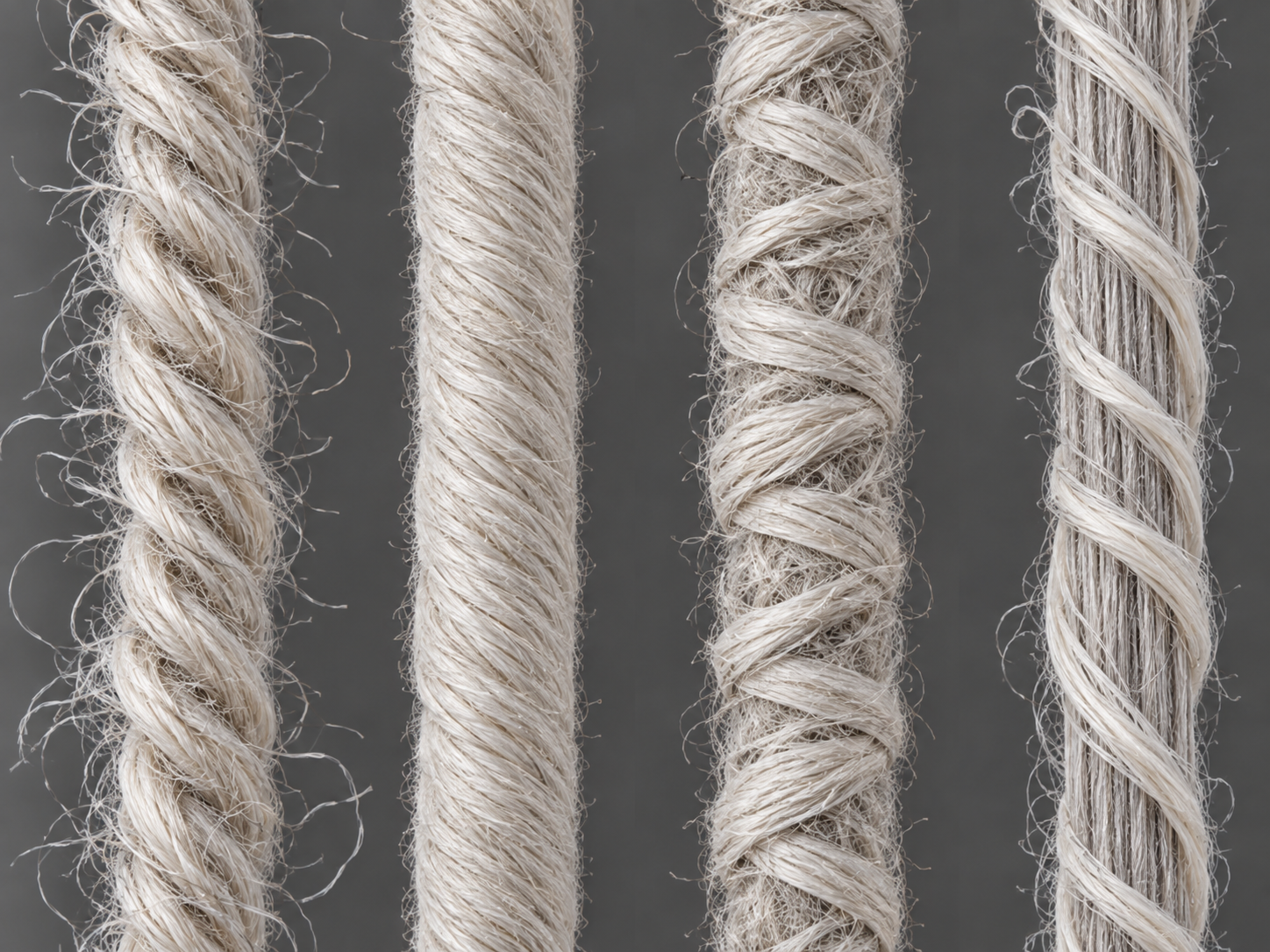
The surface of conventional ring yarn contains protruding fiber ends and loops collectively described as hairiness. Hairiness is not automatically a defect; its significance depends on the fabric, finishing processes and intended aesthetic. However, excessive or inconsistent hairiness can affect downstream processing and appearance. Modern ring-spinning developments therefore include compact systems designed to reduce the width of the fiber strand immediately before twist insertion.
Compact, Rotor and Air-Jet Spinning
Compact spinning modifies ring spinning by condensing the drafted fiber strand before twist is inserted. Better control of edge fibers allows more of them to become integrated into the yarn body. Commercial compact systems are associated with lower hairiness and improved yarn tenacity compared with corresponding conventional ring yarns. The essential principle is therefore not simply additional twist but improved fiber control in the critical zone before yarn formation.
Rotor spinning, also called open-end rotor spinning, follows a different yarn-formation mechanism. Fibers are separated from the feed sliver, transported into a rapidly rotating rotor and collected before being withdrawn as yarn. Rotor spinning avoids the conventional ring-spinning roving stage and can achieve high production rates. Its yarn architecture differs from ring yarn because fibers are deposited and incorporated through the rotor process rather than being continuously twisted from an intact drafted fiber strand.
Air-jet and vortex-type systems use controlled air flows to create yarn structure at high delivery speeds. A characteristic structure can contain relatively straight core fibers bound by surface wrapper fibers. These systems should not be treated as interchangeable with ring or rotor spinning merely because all can process staple fibers. Rieter's technical comparison of ring, compact, rotor and air-jet technologies emphasizes that each produces different yarn properties and has distinct economic and application advantages. Selection therefore depends on the required combination of count, raw material, yarn structure, productivity and downstream performance.
Yarn Count, Twist and Structural Variables
Yarn count expresses linear density or fineness and is indispensable when specifying spun yarn. Direct systems such as tex express mass per unit length, while indirect systems such as English cotton count, Ne, express length per unit mass. A finer yarn therefore has a lower tex value but a higher Ne value. Count alone does not determine quality: two yarns of equal nominal count may have substantially different strength, hairiness, evenness and fiber composition.
Twist is another major structural variable. Twist binds staple fibers into a coherent strand and is commonly described by twists per unit length together with the twist direction, designated S or Z according to the visible slope of the helices. The optimum level is application-specific. Too little twist may provide inadequate cohesion and strength; progressively higher twist usually increases fiber binding until other structural effects become dominant. High twist also changes yarn compactness, extensibility, surface character and fabric handle.
Manufacturing variables interact rather than operating independently. Fiber length distribution affects how successfully a chosen twist holds the structure together. Drafting quality influences mass variation. Spinning-system geometry affects fiber orientation and surface structure. Consequently, meaningful yarn specification commonly combines raw-material information, count, twist, spinning technology and measured quality parameters instead of relying on a single descriptive term such as fine, soft or strong.
Carded, Combed, Single, Plied and Specialty Spun Yarns
Spun yarns can be classified by both preparation route and final construction. Carded yarn is produced from fibers that have undergone carding without the additional combing stage. Combed cotton yarn receives further preparation intended to remove a proportion of shorter fibers and improve fiber arrangement. Combing adds processing and raw-material loss but can support smoother, more uniform yarn structures where those properties justify the cost.
A single yarn emerges from the primary spinning process as one strand. Two or more singles can subsequently be twisted together to form plied yarn. Plying can improve structural balance, abrasion behavior, regularity and strength, depending on fiber, count and twist relationships. Further combinations can form cabled constructions.
Special structures extend the spun-yarn concept. Core-spun yarn places staple fibers around a continuous or previously formed core, allowing properties of the core and sheath to be combined. Elastic cores are widely used where stretch is required, while non-elastic cores can provide other mechanical characteristics. Spun silk is another distinct category: unlike reeled continuous-filament silk, it is manufactured from shorter silk fibers that can be processed as staple material. These examples demonstrate why fiber form, spinning method and yarn construction should always be stated separately when technically identifying a yarn.
Quality Evaluation and Laboratory Testing
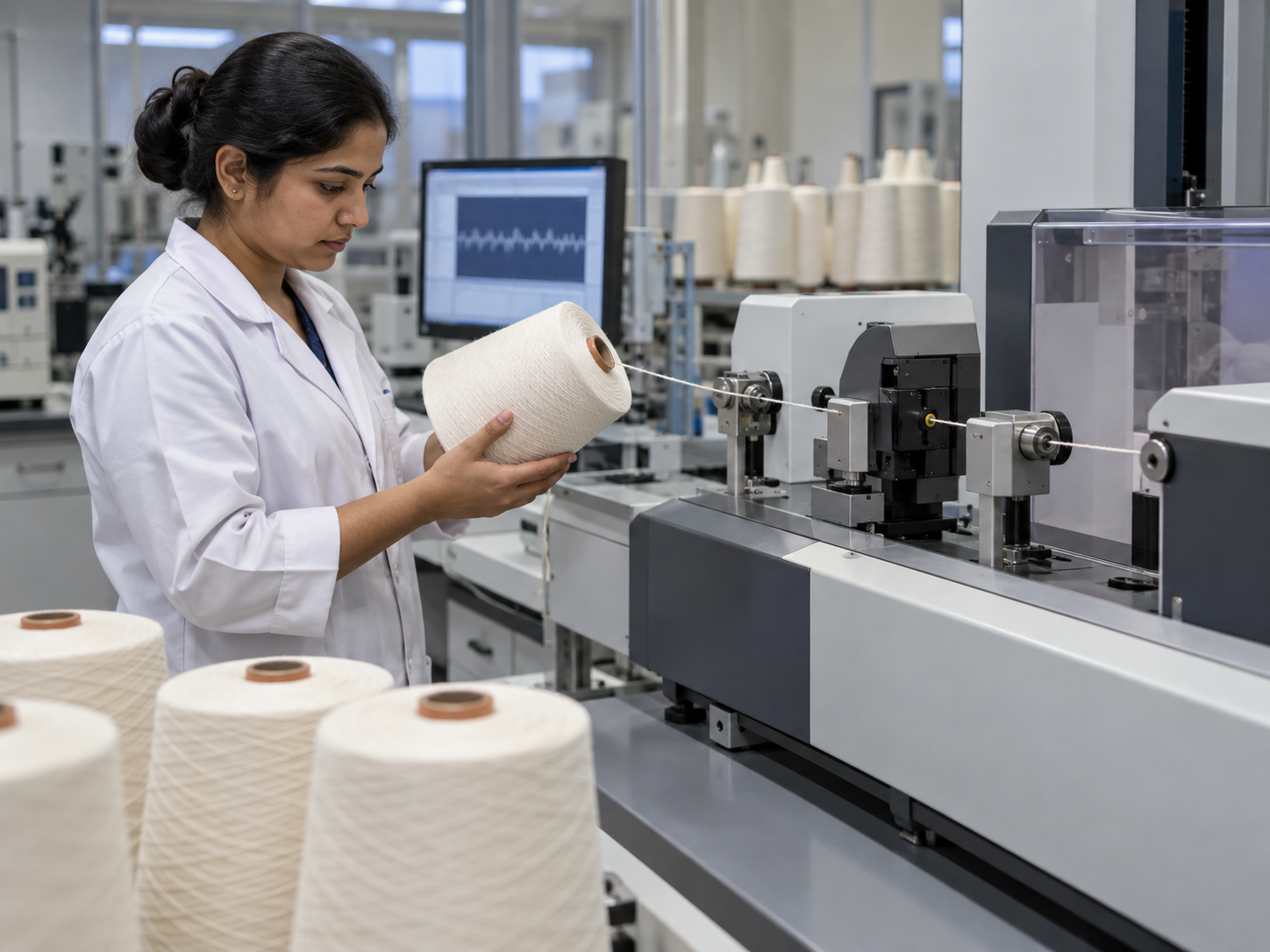
Commercial spun-yarn quality is evaluated through measurable properties rather than appearance alone. Important parameters include linear density, mass variation, tensile strength and elongation, imperfections and hairiness. The relative importance of each measurement depends on the yarn's intended process and end use.
Evenness testing examines variations in mass along the yarn. Local thin places, thick places and neps can influence fabric appearance and may signal problems in raw material or processing. Tensile tests establish breaking force or tenacity and elongation, helping mills judge whether yarn can tolerate stresses during winding, warping, weaving or knitting. Hairiness measurements characterize fibers extending from the yarn body; they are particularly useful when comparing spinning systems or monitoring process consistency.
Uster Technologies identifies its Uster Tester platform as a widely used laboratory system for staple-yarn quality testing, with sensors for mass variation, imperfections and hairiness. Modern mill quality control increasingly combines laboratory measurements with in-line monitoring. Statistical interpretation is essential because a yarn package contains very great lengths of material: quality management therefore depends on detecting distributions, trends and abnormal events rather than assuming that a few isolated observations represent the whole production lot.
How Spinning Method Influences Fabric Performance
The importance of spun-yarn structure becomes most visible after the yarn enters knitting, weaving and finishing. Strength and elongation affect the ability to withstand processing tension. Unevenness can produce barré, streakiness or other appearance problems, while excessive faults can cause machine stoppages. Hairiness influences lint generation, surface character and interactions between adjacent yarns.
Ring-spun yarn is frequently selected when fine counts, versatility and conventional yarn structure are priorities. Compact yarn can be advantageous when reduced hairiness or improved fiber integration is desired. Rotor yarn offers a different balance between productivity, structure and performance and has important applications in products for which its characteristic properties are appropriate. Air-jet systems provide another combination of high production speed, relatively low surface hairiness and distinctive yarn architecture.
The fiber itself remains equally important. A cotton ring yarn and a polyester ring yarn do not become equivalent merely because they use the same spinning principle. Fiber moisture behavior, modulus, strength, surface friction, thermal response and other material properties continue to influence processing and the resulting textile. Yarn engineering therefore treats the spinning system as one component of a larger fiber-yarn-fabric relationship.
Production Economics and Sustainability Considerations
The environmental and economic profile of spun yarn cannot be reduced to one spinning technology. Raw-material production, fiber preparation, energy consumption, waste, machine productivity, yarn quality and downstream processing all contribute to the final outcome. A system that produces yarn rapidly may reduce certain manufacturing inputs per kilogram, while another may deliver properties that improve process efficiency or enable a different product lifetime. Meaningful comparisons therefore require a defined yarn, material and end use.
Fiber utilization is particularly important because opening, carding and combing can generate recoverable or non-recoverable waste streams. Combing intentionally removes material containing shorter fibers and other components to refine the feedstock, so its quality benefits have a corresponding yield implication. Some textile waste can be mechanically recycled back into fibrous form, but recycled fibers are often shorter or less uniform than virgin feedstock and may require blending or process adjustments to maintain spinning performance.
Energy is another significant mill consideration. Ring, compact, rotor and air-jet systems use different machine architectures and production speeds, so comparisons should be made on equivalent production and quality requirements rather than by generalizing that one method is universally sustainable. Increasingly sophisticated controls, automated material handling, quality monitoring and process optimization offer opportunities to reduce avoidable waste and improve first-quality output.
Industry, Research and Technical Knowledge Ecosystem
Spun-yarn technology is supported by machinery manufacturers, testing specialists, fiber organizations and academic institutions. Rieter develops industrial systems spanning ring, compact, rotor and air-jet spinning and publishes technical comparisons of the structures and economics associated with these technologies. Uster Technologies specializes in textile quality-control instrumentation and statistical quality systems used by spinning mills.
Cotton Incorporated's CottonWorks educational platform provides technical material on cotton yarn manufacturing, including ring and rotor spinning. The Woolmark Company documents woollen and worsted processing and explains how spinning extends prepared fiber into a continuous yarn while inserting the twist required for subsequent processing. The Textile Institute maintains professional textile terminology resources and publishes specialist books covering conventional and advanced yarn-spinning technologies.
Academic textile-engineering programs also remain important because yarn manufacture combines fiber science, mechanical engineering, process control, statistics and product design. NPTEL coursework from the Indian Institute of Technology system, for example, addresses ring, rotor, air-jet, vortex and other spinning mechanisms. Collectively, these institutions illustrate how contemporary spinning combines long-established textile principles with automation, sensing, data analysis and continuing machine development.
Spun Yarn as the Link Between Fiber and Fabric Performance
Spun yarn transforms finite-length fibers into a practical continuous textile structure. Its performance arises from the interaction of fiber properties, preparation, drafting, yarn-forming mechanism, count and twist. Ring spinning achieves cohesion through continuous drafting and twist; compact spinning improves fiber control before twist insertion; rotor and air-jet technologies form distinctly different structures while offering alternative productivity and processing characteristics. None can be described as universally superior without specifying the raw material and intended textile.
This structural perspective explains why apparently similar yarns can behave differently during knitting, weaving and finishing. Fiber length distribution, alignment, yarn irregularity, tensile properties and hairiness influence both processing efficiency and fabric appearance. Carding, combing, plying and specialty constructions such as core spinning add further design variables. Reliable quality control therefore depends on objective measurements of count, evenness, imperfections, strength, elongation and surface characteristics rather than on trade descriptions alone.
Spun-yarn manufacturing continues to evolve through compacting systems, higher-speed spinning, automated handling, in-line sensing and increasingly integrated mill data. At the same time, pressure to improve fiber utilization, energy efficiency and recycled-fiber processing is expanding the technical demands placed on spinning systems. For textile students and professionals, spun yarn remains a foundational subject because it is the engineering link through which the characteristics of staple fibers are translated into the performance, economics and appearance of finished fabrics.