Share on X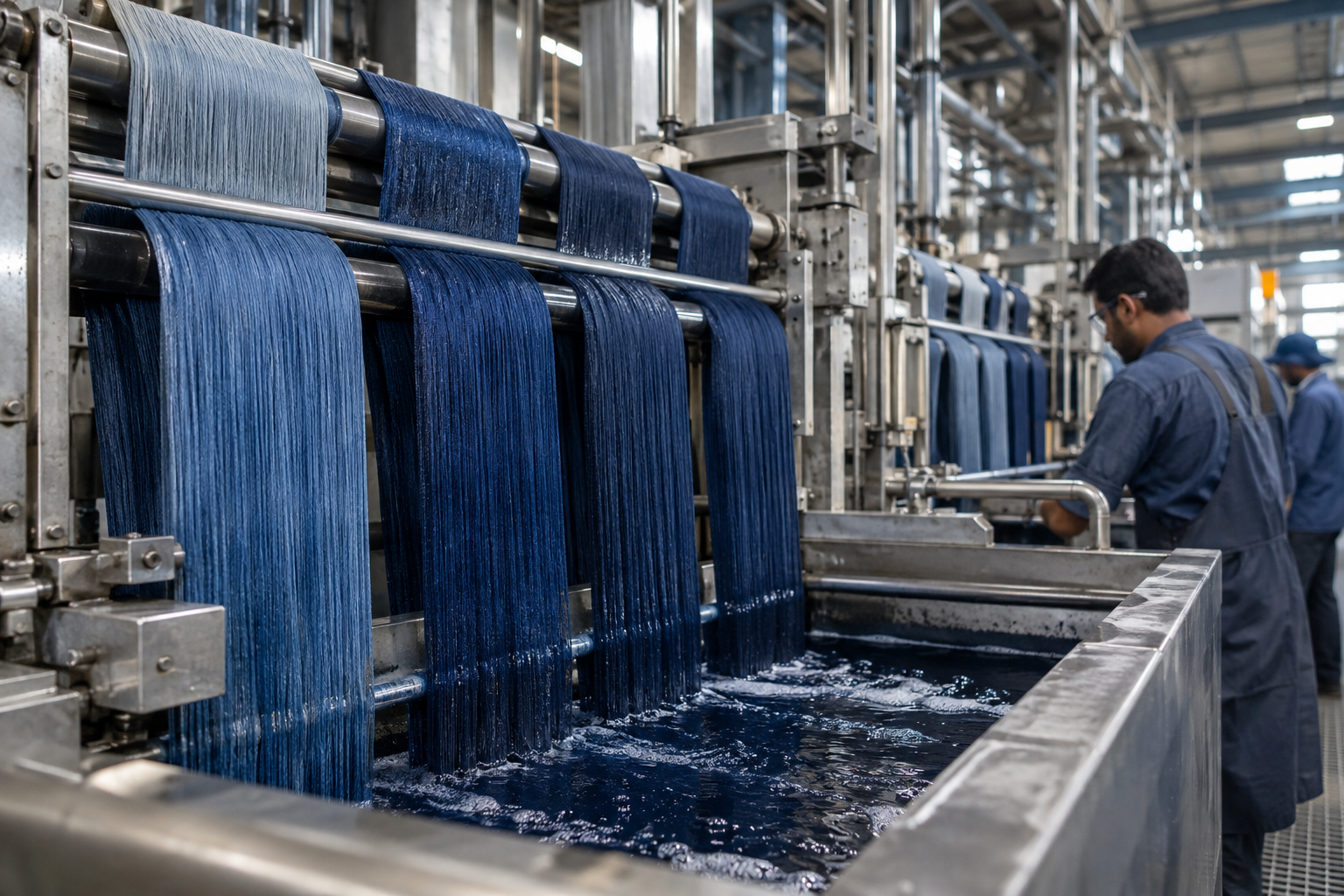

Indigo is one of the most recognizable textile colorants in the world, yet the expression indigo dyed describes far more than a particular shade of blue. In textile technology, it normally means that a fibre, yarn, fabric, or garment has been coloured with indigo, a vat dye whose distinctive chemistry requires reduction to a soluble form before application and oxidation afterward to regenerate the familiar blue pigment. The process is especially important to cotton denim, where indigo's relatively low affinity for cellulose and tendency toward surface-oriented coloration create the progressive fading that has become central to the appearance of jeans.
Indigo also belongs to a much older textile tradition. Plant-derived indigo has been used in Asia, Africa, and other regions for centuries, while synthetic indigo transformed industrial dyeing from the late nineteenth century onward. Modern production therefore spans craft fermentation vats, synthetic indigo powders, pre-reduced liquid products, continuous rope and slasher ranges, and emerging electrochemical and biological reduction technologies. Understanding indigo requires separating the dye molecule from the plants that may supply it, distinguishing indigo from other blue dyes, and recognizing that an indigo-looking textile is not necessarily indigo dyed. For textile students and professionals, the subject connects colour chemistry, yarn engineering, denim construction, dyehouse control, finishing, fashion aesthetics, wastewater management, sourcing, and circularity.
What Indigo Dyeing Means in Textile Technology
In textile terminology, indigo generally refers to the blue colorant whose principal colouring compound is indigotin, commonly identified as C.I. Vat Blue 1. PubChem lists the molecular formula of indigo as C16H10N2O2. Indigo may be obtained from plant materials or manufactured synthetically; the origin does not create a fundamentally different indigotin molecule merely because one product is described as natural and another as synthetic.
Several distinctions matter. Indigofera is a botanical genus that includes plants historically used as sources of indigo precursors; it is not itself the dye molecule. Indigo carmine is a chemically modified, water-soluble blue colorant and should not be treated as interchangeable with ordinary textile indigo. Likewise, garments marketed as "indigo colour" may use reactive, sulphur, pigment, disperse, or other dyes that imitate an indigo-like hue.
The phrase indigo-dyed denim usually refers to denim in which predominantly the warp yarns are dyed blue while the weft remains undyed or differently coloured. However, indigo can also be used in woven and knitted textiles outside classic denim, in yarn dyeing, piece dyeing, resist dyeing, craft textiles, and specialised fashion applications.
Historical Development from Natural Indigo to Synthetic Production
Indigo dyeing predates modern denim by many centuries. The Victoria and Albert Museum documents long-standing use of indigo from Indigofera plants in Indian textiles, particularly cotton. Related traditions developed across Asia and Africa, often combining indigo vats with resist techniques such as tying, stitching, paste application, or folding. Yoruba àdìrẹ textiles from south-western Nigeria, for example, represent a historically important indigo-resist tradition.
Natural indigo manufacture typically does not involve simply squeezing blue dye from a blue leaf. Plants contain precursors that must undergo biochemical and chemical transformations before insoluble indigo pigment is formed. Traditional methods vary greatly by geography, plant species, fermentation practice, alkali source, vat maintenance, and local craft knowledge.
The nineteenth-century development of synthetic organic chemistry changed the economics of indigo. Smithsonian's National Museum of American History records that BASF introduced a process for mass-producing synthetic indigo in the late 1890s. Industrial synthetic indigo subsequently displaced much natural-indigo production because it offered standardized concentration, scalable supply, and greater manufacturing consistency. Natural indigo nevertheless survives in heritage textiles, craft production, premium fashion, agricultural projects, and research into bio-based coloration.
Why Indigo Requires Reduction and Oxidation
Indigo's behaviour differs from that of a conventional water-soluble dye. Oxidized blue indigo has very low water solubility and cannot simply be dissolved in water and exhausted onto cotton. Before dyeing, the molecule is reduced to a soluble leuco form under alkaline conditions. Industrial systems commonly use sodium dithionite, also called sodium hydrosulphite, together with sodium hydroxide, although alternative reducing technologies are increasingly studied.
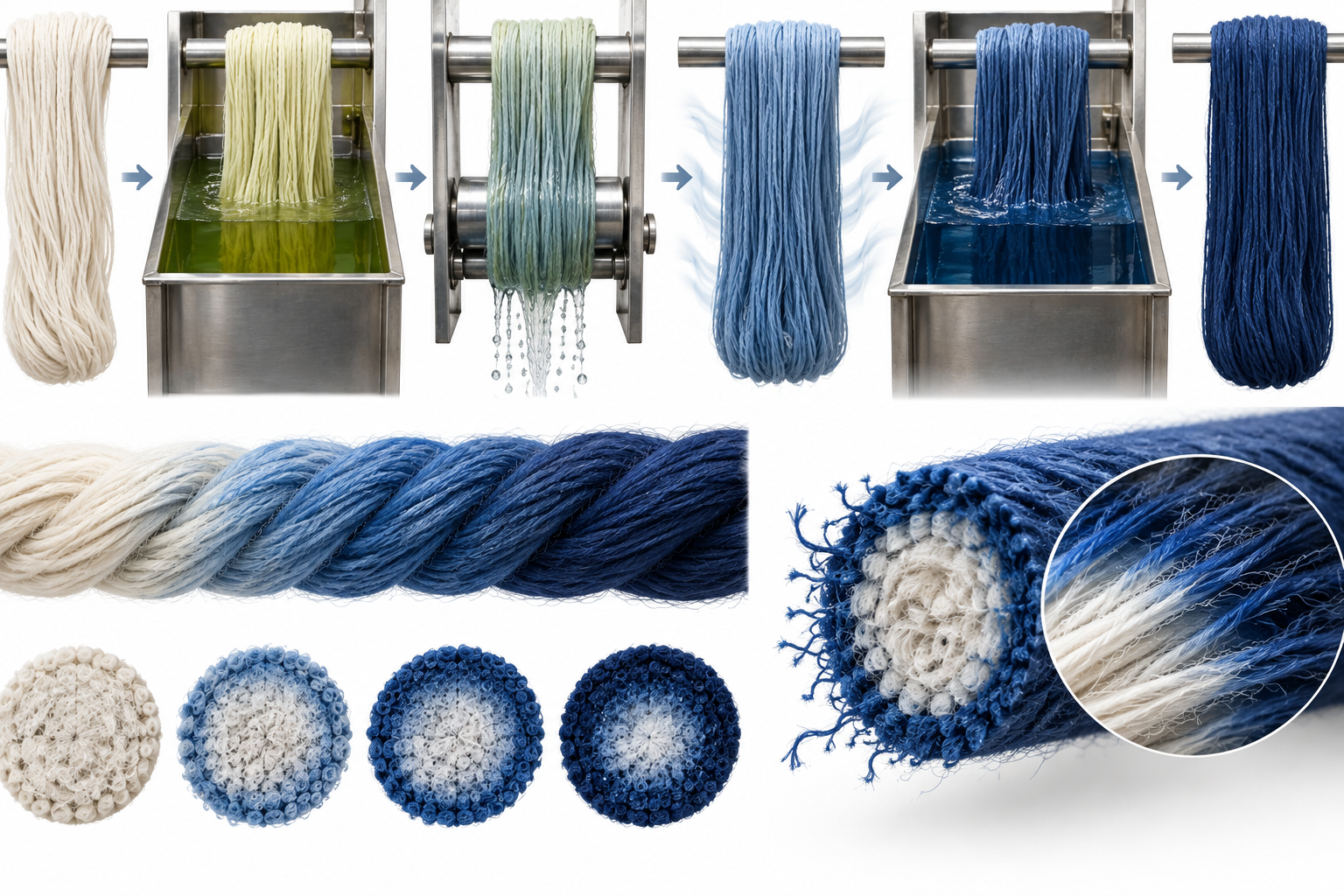
The reduced leuco form has greater affinity for cellulosic fibre and can penetrate or deposit on cotton. After the yarn or fabric leaves the dyebath, exposure to oxygen converts the reduced species back into insoluble blue indigo. Industrial denim ranges therefore commonly alternate immersion or padding with controlled periods of air exposure. Multiple dip-and-oxidation cycles progressively build shade.
Dyebath pH, redox potential, indigo concentration, reducing-agent concentration, temperature, immersion time, squeezing pressure, airing time, yarn preparation, and liquor circulation can all influence colour yield and reproducibility. Research summarized by ScienceDirect notes that the distribution of reduced indigo species varies with pH and that conditions around pH 10.5–11.5 can favour the monoionic form associated with useful colour yield and ring-dyeing behaviour. Actual mill settings must be developed for the dye system, machinery, yarn, shade, and supplier recommendations rather than treated as universal recipes.
Ring Dyeing and the Characteristic Fading of Denim
One of indigo's most commercially valuable characteristics is that it can produce comparatively superficial coloration of cotton yarn. In denim manufacturing this is often described as ring dyeing: the outer regions of the yarn become strongly coloured while the centre remains lighter or substantially undyed. The term describes a cross-sectional distribution of colour, not a separate chemical class of indigo.
This structure helps explain why blue jeans develop high-low effects, whiskers, abrasion marks, seam highlights, and other forms of wear. Mechanical abrasion and laundering gradually remove or expose the indigo-rich outer fibre layers, revealing lighter material underneath. The resulting change in appearance is therefore closely connected with dye distribution, yarn structure, fabric construction, garment finishing, and wear.
A deeper initial shade is not automatically produced by forcing indigo farther through the yarn. Denim designers may deliberately engineer superficial deposition because it improves wash-down contrast. Conversely, products intended to retain colour may require different dyeing, finishing, construction, and laundering strategies. The ideal degree of ring dyeing is consequently an aesthetic and technical specification rather than a simple quality ranking.
Rope, Slasher, Sheet and Other Industrial Indigo Processes
Continuous warp dyeing dominates conventional blue-denim production. Two important approaches are rope dyeing and slasher or sheet dyeing. In rope dyeing, large numbers of warp yarns are gathered into rope-like assemblies, prepared, passed repeatedly through indigo dye boxes and oxidation zones, washed, dried, and later opened and arranged for subsequent processes such as beaming and sizing. Rope systems are strongly associated with classic denim manufacture and can provide good shade development and characteristic ring-dyed effects when well controlled.
In slasher or sheet dyeing, warp yarns travel as a broad parallel sheet. CottonWorks notes that adapted slasher systems can combine indigo dyeing with subsequent sizing and that multiple dip-and-sky cycles are used where deeper shades are required. Sheet processing can simplify certain material-handling stages, although equipment configuration, productivity, yarn count, shade requirements, and desired aesthetics influence the choice between technologies.
Loop dyeing and other modified continuous arrangements have also been developed. Whatever the machine design, the essential manufacturing sequence remains controlled preparation, reduced-indigo application, squeezing, oxidation, repeated shade build-up where necessary, washing or neutralisation, drying, and preparation for weaving. Uniform yarn tension and stable dye chemistry are critical because variation may become visible across the finished denim width.
Fibres, Yarn Structure and Fabric Construction
Cotton is indigo's most commercially important textile substrate, particularly in denim. Classic denim is normally a warp-faced woven fabric, frequently based on a twill construction, in which blue warp yarns visually dominate the face while lighter weft yarns contribute to the reverse-side appearance. Modern denim may also contain regenerated cellulosic fibres, elastane, polyester, or other components, but their presence changes processing and performance considerations.
Yarn parameters influence the final indigo effect. Yarn count, twist, hairiness, fibre quality, open-end or ring-spun construction, compact spinning, slub effects, and preparation determine wetting, penetration, surface area, abrasion behaviour, and eventual wash-down. Poor preparation may produce uneven dye uptake even when the indigo bath itself is chemically stable.
The textile construction should therefore be considered together with colouration. Two fabrics made with nominally similar indigo shades may fade very differently because their yarn structures, weave densities, warp-to-weft colour relationships, finishing histories, and garment wash treatments differ. Indigo is consequently not just a colour specification; in denim it becomes part of an engineered material system extending from fibre selection to consumer use.
Shade Variations, Topping, Bottoming and Fashion Effects
Commercial indigo denim ranges from pale washed blues to extremely dark shades, but depth alone does not define the product. Hue or cast may appear redder, greener, cleaner, duller, or more grey depending on the indigo product, dyeing conditions, companion dyes, washing, finishing, and optical context.
Denim manufacturers may combine indigo with sulphur dyes or other colourants. Bottoming generally places another colour beneath subsequent indigo application, while topping applies another colour after the indigo stage. These approaches can modify depth, cast, wash-down behaviour, or fashion appearance. Black-denim and coloured-denim technologies may use little or no indigo at all, so the word denim must not be assumed to mean indigo dyed.
Resist processes form another important family. Tying, stitching, folding, clamping, waxes, pastes, and other barriers can selectively prevent dye access and create patterns. Such techniques occur in culturally distinct traditions and should not be collapsed into a generic fashion category without acknowledging their specific histories. Industrial denim finishing, by contrast, commonly uses controlled abrasion, enzymes, lasers, ozone, or washing systems to alter an already dyed garment's surface appearance.
Quality Control, Testing and Common Defects
Indigo quality begins in the dyehouse but must ultimately be evaluated on yarn, fabric, and garment performance. Process control commonly monitors parameters such as pH, oxidation-reduction potential, reduced-indigo concentration, bath temperature, chemical additions, line speed, pick-up, squeezing pressure, immersion time, and oxidation time. Shade evaluation should consider both absolute colour and variation across and along production.
Important textile tests may include instrumental colour measurement, wash fastness, dry and wet rubbing or crocking fastness, dimensional stability, tensile or tear performance where applicable, and assessment of shade change after specified laundering or finishing. Test methods should be selected from the buyer's specification or recognized standards rather than assumed to be interchangeable.
Potential defects include uneven shade, streaks, side-to-centre variation, poor penetration control, excessive rubbing colour transfer, inconsistent wash-down, yarn breakage, contamination, and unwanted hue changes. Not every visible variation is a defect: some denim deliberately incorporates irregular yarns, differential fading, or vintage effects. Quality therefore means conformity to a defined target rather than perfect visual uniformity in every indigo product.
Care, Handling and Colour Transfer
Fresh dark indigo textiles can release surface colour through rubbing or laundering, particularly when the product has been designed for strong fade potential. This phenomenon is familiar with raw or minimally washed denim. Contact with light upholstery, footwear, bags, or other garments can therefore produce unwanted colour transfer.
Care instructions should always follow the garment manufacturer's label, because fibre blends, elastane, coatings, trims, finishes, and garment construction may impose requirements unrelated to indigo itself. In general, unnecessarily aggressive washing, strong oxidizing bleaches, high mechanical action, and repeated high-temperature laundering can accelerate appearance change. Turning jeans inside out, using appropriate detergent, avoiding unnecessary washing, and allowing garments to dry without excessive heat may help preserve colour and structure when compatible with the care label.
Consumers sometimes treat all indigo fading as damage. In many denim products, however, controlled fading is an intended design feature. Manufacturers and retailers should therefore communicate whether a garment is designed to maintain shade, develop a personalised patina, or undergo a particular wash-down profile.
Environmental Challenges and More Sustainable Indigo Dyeing
The sustainability debate around indigo cannot be reduced to a simple contest between "natural" and "synthetic." Environmental performance depends on agricultural inputs where plants are grown, chemical synthesis, dye concentration, reducing chemistry, water and energy use, wastewater composition, transport, yield, process efficiency, garment finishing, durability, use, and end-of-life pathways.
Conventional industrial indigo commonly relies on sodium dithionite. Research in the Journal of Cleaner Production identifies sulphite and sulphate by-products as one reason to investigate alternative reducing systems. Published research has examined reducing sugars, electrochemical reduction, improved bath management, biological approaches, nitrogen-protected processes, foam application, and reduced-water systems. A 2023 production-scale study demonstrated that indirect cathodic reduction can replace dithionite under investigated industrial conditions while producing denim comparable in shade and depth to a reference process.
Water reduction must also be considered across both dyeing and finishing. Highly engineered indigo colouration followed by resource-intensive garment washing can shift rather than eliminate environmental burdens. Better practice therefore combines controlled chemistry, water reuse where technically viable, lower-impact reduction, wastewater treatment, efficient washing, safer finishing methods, durable garment design, repair, resale, fibre recovery, and transparent measurement of actual resource use.
Commercial Indigo and the Global Denim Technology Ecosystem
Indigo production operates through an international network of dye manufacturers, denim mills, cotton organisations, chemical suppliers, machinery builders, brands, and research institutions. Archroma supplies pre-reduced indigo systems including its DENISOL range and publicly documents indigo-related denim process technologies. Advance Denim, a major denim mill founded in China, has worked with aniline-reduced indigo technology and has also supplied material for published academic indigo research.
Cotton Incorporated, through its CottonWorks technical education platform, publishes industry training material describing denim construction and rope and slasher dyeing. Stony Creek Colors has commercialised plant-derived indigo for denim applications and has collaborated with Archroma on scaled pre-reduced natural indigo production. Historically, BASF occupies an important place in the industrialisation of synthetic indigo; Smithsonian records its introduction of a mass-production process in the late nineteenth century.
These entities represent different parts of the value chain rather than equivalent businesses. Chemical producers should not be confused with denim mills, agricultural indigo suppliers, educational organisations, or apparel brands. For sourcing professionals, direct verification of dye identity, restricted-substance compliance, concentration, traceability, wastewater claims, and mill process capability remains essential.
Research Directions and the Future of Indigo Textiles
Current indigo research is focused less on replacing the visual identity of denim than on achieving it with tighter chemistry, lower resource consumption, fewer problematic by-products, and greater process control. Electrochemical reduction is particularly significant because it seeks to replace disposable reducing chemicals with electrically regenerated redox systems. Laboratory and production-scale studies show technical promise, although capital requirements, electrolyte management, robustness, maintenance, and mill integration determine whether a method succeeds commercially.
Other approaches include improved plant-derived indigo, biotechnology, fermentation control, pre-reduced liquid products, alternative reducing agents, nitrogen-protected dyeing, foam application, digital process monitoring, closed-loop washing, and dye formulations with tighter impurity specifications. Cleaner dyeing must also connect with cleaner garment finishing, since dramatic fading effects can otherwise consume resources after the yarn has already been efficiently dyed.
Future denim development is likely to treat indigo as part of an integrated design system: fibre choice, dye chemistry, yarn architecture, laser response, wash-down target, durability, recyclability, and factory resource management will increasingly be considered together rather than as isolated steps.
Indigo Dyeing's Continuing Role in Modern Textile Manufacturing
Indigo occupies an unusual position in textile technology because characteristics that might be disadvantages in another dye can become valuable design tools. Its insolubility requires reduction and oxidation; its limited affinity for cotton encourages surface-oriented colouration; and that surface distribution makes controlled fading possible. These mechanisms connect molecular chemistry directly with the familiar appearance of worn denim.
At the same time, indigo reaches far beyond jeans. Plant-based dyeing traditions in India, Africa, and other regions preserve sophisticated knowledge of vats and resist patterning, while modern mills operate highly controlled rope and slasher ranges at industrial scale. Synthetic indigo brought consistency and volume to this market, but contemporary interest in plant-derived sources, cleaner impurities profiles, electrochemical reduction, biological processes, and lower-water technologies shows that the technology continues to evolve rather than merely preserve a historical process.
The industry's central challenge is now to retain indigo's desirable colour, reproducibility, fading aesthetics, and commercial efficiency while reducing unnecessary chemical, water, energy, and finishing burdens. No single dye source or process automatically achieves that objective. Progress depends on measurable improvements across dye manufacture, yarn preparation, application, wastewater management, garment finishing, durability, repair, reuse, and recycling. For textile scientists, designers, manufacturers, and sourcing specialists, indigo remains both a foundational colour technology and an active field of materials and process innovation.