Share on X
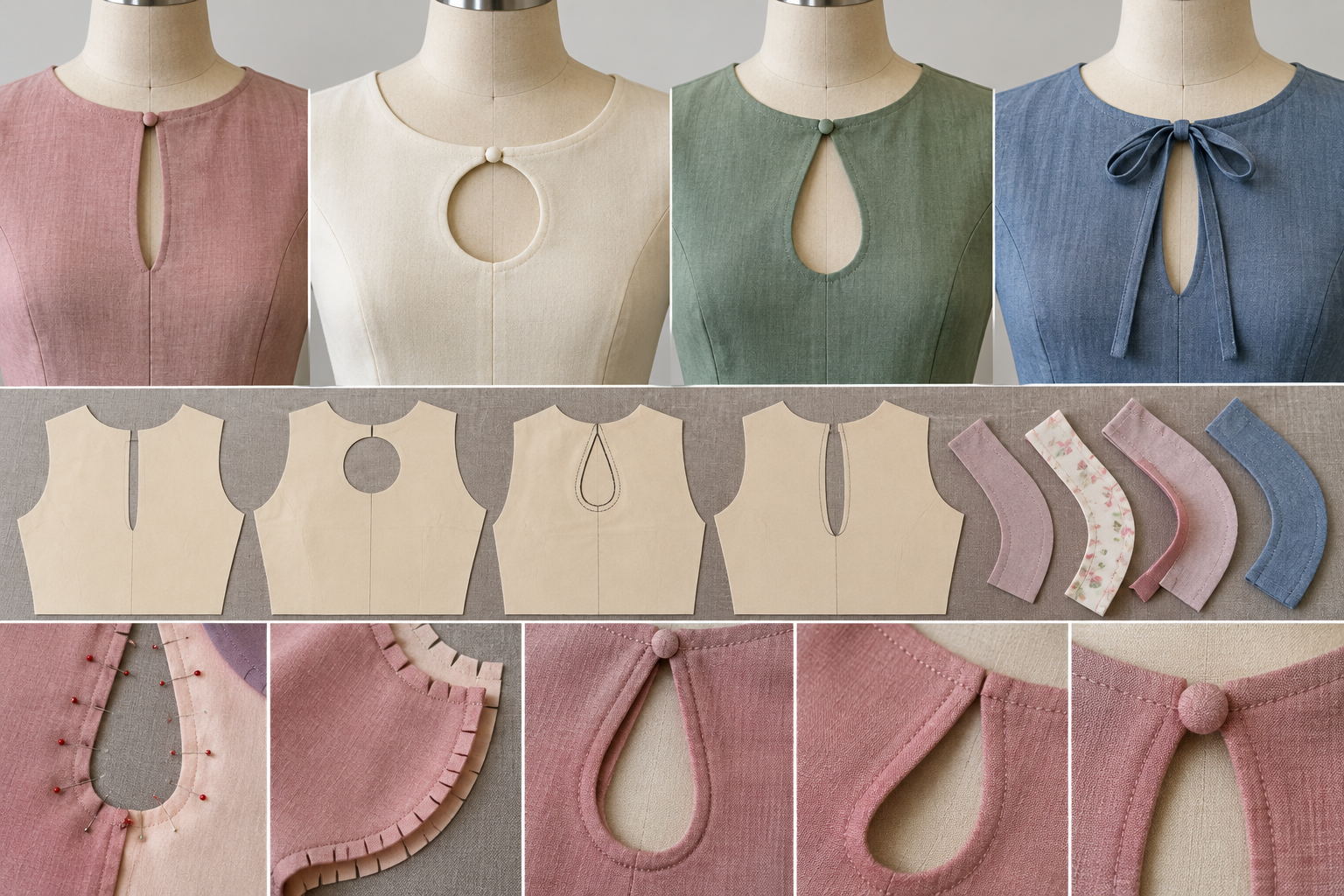

A keyhole neck, more precisely called a keyhole neckline, is a garment neckline distinguished by a deliberately shaped opening near the neck or upper chest. The opening may be circular, oval, teardrop-shaped, elongated or slit-like, and it is often closed or visually anchored at its upper end with a button-and-loop, hook-and-eye, tie, band or joining seam. Unlike a conventional V-neck or scoop neck, where the neckline edge itself creates the open area, a keyhole generally introduces an opening within or immediately below an otherwise more continuous neckline.
The detail is deceptively simple. Its visual success depends on pattern geometry, fabric behaviour, edge stabilization, accurate sewing and careful pressing. Small errors are conspicuous because the opening is usually positioned near the centre front or centre back, where asymmetry, puckering or stretching is readily visible. The keyhole neck therefore provides a useful case study in the relationship between textile properties and garment construction: grain direction, extensibility, drape, thickness, seam allowance and finishing method all influence whether the opening lies flat and retains its intended shape.
Keyhole necklines occur in blouses, dresses, tops, tunics and other garments, including Indian apparel such as contemporary saree blouses and kurtas. They can function primarily as decorative cutouts, as part of a closure system, or as a combination of both. Understanding the distinction between the design concept and the methods used to manufacture it is important for designers, pattern makers, garment technicians, students and quality-control professionals.
What Defines a Keyhole Neckline
The defining feature of a keyhole neckline is an intentional opening associated with the neckline rather than simply a low or deeply cut neck edge. Common descriptions identify the opening as round, oval, teardrop-shaped, wedge-like or slit-like. It may sit directly below a high neckline, interrupt the centre of a neckline, or extend downward from the neck edge.
The term is therefore better understood as a design family than as one rigid geometric specification. A small vertical slit secured by a button and loop may be sold as a keyhole neck, while another garment may contain a clearly enclosed oval or teardrop aperture. In both cases, the visual principle is a controlled area of negative space around the neckline.
A front keyhole can expose a small area of the upper chest while preserving a relatively high surrounding neckline. A back keyhole may serve the additional practical purpose of enlarging the head opening so that a close neckline can be put on without a long zipper or excessively stretchable neck edge. The exact function depends on the pattern rather than on the name alone.
Keyhole Neck, Split Neck and Other Similar Necklines
Several neckline terms are easily confused because they can produce similar silhouettes. A split neck normally begins at the neckline edge and extends downward as an open slit. A keyhole may also be slit-like, but the most characteristic versions create a bounded or visually enclosed opening, often with the sides reconnecting above it.
A round neck describes the overall curved neck edge. Designers frequently combine a round or jewel-like neckline with a keyhole cutout below the centre front, so the two descriptions can apply to the same garment at different levels: one identifies the base neckline and the other identifies the added opening.
A V-neck is formed by the neck edge converging into a V. It does not require an enclosed internal opening. A halter construction, meanwhile, concerns how the garment is supported or shaped around the neck and shoulders. Some halter garments contain openings that resemble keyholes, but a keyhole neckline does not automatically make a garment a halter top.
These distinctions matter in specifications and production communication. Describing the base neckline, keyhole dimensions, closure and finishing method separately is more precise than relying on the term "keyhole neck" alone.
Keyhole Shapes, Placement and Design Variations
Keyhole openings can be varied substantially without losing their basic identity. Rounded forms provide a soft transition from the neckline, while narrow teardrops create greater vertical emphasis. An elongated oval or slit can visually lengthen the upper torso; wider openings make the cutout more prominent and demand greater attention to fit and coverage.
Placement is commonly centred on the front or back because symmetry gives a deliberate visual effect and simplifies alignment with centre-front or centre-back pattern lines. Off-centre and shoulder-adjacent interpretations are also possible, although these move toward the broader category of decorative garment cutouts.
The upper ends may meet permanently, be joined by a fabric bridge, or use a button-and-loop, hook-and-eye or tie closure. Ties change both appearance and function because they allow some adjustment. A buttoned back keyhole can provide dressing access while maintaining a close-fitting neckline.
Scale should be evaluated on the actual body or dress form. Enlarging an opening changes more than appearance: it can alter neckline stability, garment modesty, stress distribution and the amount of reinforcement needed. In production, therefore, keyhole width, depth, location and closure position should be treated as measurable pattern specifications.
Pattern Development and Textile Behaviour
A successful keyhole begins at the pattern stage. The designer establishes the opening relative to the centre line, neckline seam and bust or upper-back area. The pattern maker then provides the seam allowance and whichever finishing components the construction requires, such as a shaped facing, bias facing, binding, separate neckband or closure loop.
Fabric behaviour is critical. Cutting an opening interrupts the continuity of the textile structure and exposes edges that may stretch, fray or distort. Curved portions may contain sections approaching the bias direction, where woven fabrics can deform more readily than along straight grain. Threads magazine therefore recommends stabilizing curved garment edges with staystitching when preparing them for bias facing.
Drape also changes the result. Fluid fabrics can produce an elegant opening but may shift during sewing or pressing. Firm woven fabrics retain geometry more easily but can become bulky when several facing and seam-allowance layers accumulate. Knitted fabrics introduce stretch and recovery considerations and may require a different edge finish from a woven garment.
For industrial development, the desired appearance should therefore be tested in the production fabric rather than approved only from a paper pattern or digital sketch.
Construction Methods for a Keyhole Neck
There is no single mandatory method for sewing a keyhole neckline. The construction is selected according to shape, fabric, garment quality level and intended appearance.
- Bias facing: A bias-cut strip is stitched around the curved opening and turned to the garment interior. Bias allows the strip to conform to curved edges. Megan Nielsen Patterns demonstrates this method specifically for a keyhole neckline, while Threads describes bias facing as a general technique for shaped garment edges.
- Shaped facing: A separate fabric piece reproduces the neckline and keyhole contour. This can produce a clean exterior with no visible binding but adds layers and must be controlled so the facing does not roll outward.
- Binding: The raw edge can be enclosed by a narrow strip that remains visible or forms part of the design.
- Turned and topstitched edge: Certain patterns permit the allowance around a sufficiently manageable opening to be clipped, turned inward, pressed and topstitched. Mood Fabrics demonstrates such an approach on its Topeka keyhole dress.
Regardless of method, accurate clipping or trimming around curved seam allowances, controlled pressing and careful alignment are essential. The pattern instructions should take precedence over generic sewing rules because allowance widths and construction sequences vary.
Facings, Clipping, Understitching and Pressing
Finishing operations determine whether a keyhole appears crisp or homemade. The CBSE Fashion Studies practical manual describes bias facing as a bias-cut strip attached to the neckline and turned to the inside so it should not show from the right side. It also instructs students to clip curved seam allowances, a standard technique that allows an inward curve to spread when turned.
When a facing is used, understitching can help keep the seam rolling toward the garment interior. Understitching joins the facing to the seam allowances close to the seam without stitching through the garment outer layer. Not every keyhole construction permits continuous understitching, especially around very narrow points, but the principle is valuable wherever access allows.
Pressing should shape rather than distort the fabric. Bias strips can stretch during handling, which is why Threads recommends shaping a bias strip to resemble the curved garment edge before or during application. Megan Nielsen's keyhole tutorial similarly emphasizes pressing the opening into its intended form and allowing susceptible fabric to cool in shape.
Sharp lower points, tight curves and narrow bridges demand particular care. Excess seam allowance can cause bulk, while over-clipping can weaken the seam. Production samples should establish the appropriate trimming and pressing sequence for the chosen textile.
Fabric Choice, Interfacing and Reinforcement
Keyhole necklines can be used on many fabrics, but the same pattern cannot be expected to behave identically across materials. Lightweight cottons, rayon-type fabrics and other drapable wovens readily form soft keyhole shapes, yet their edges may require stabilization to prevent stretching. Crisp fabrics can preserve defined geometry but reveal puckering immediately if the seam is not smooth.
Very thick fabrics present another problem: multiple layers of garment, facing, seam allowance and closure components can create a raised edge around a small opening. A lower-bulk finish may therefore be preferable. The general advantage of bias facing is that it can finish a curved edge with less bulk than some full shaped facings.
Interfacing is not automatically required for every keyhole. Its use should respond to the fabric, closure and construction. Areas supporting a button, hook or other concentrated load may benefit from localized reinforcement, while unnecessary stiffening can change the drape of a delicate neckline.
Sampling should evaluate seam slippage, fraying, stretch recovery, visible impression of internal layers and response to laundering or cleaning. For manufacturers, the question is not simply whether a fabric can be sewn into a keyhole, but whether the opening remains stable and attractive during repeated use.
Fit, Comfort and Functional Considerations
Although a keyhole is often regarded as decorative, it interacts with fit. The opening should lie against or fall consistently from the body rather than gape unpredictably. Gaping can originate from excessive keyhole width, insufficient neckline stabilization, unsuitable fabric stretch, incorrect pattern shaping or broader bodice-fit problems.
Front openings require deliberate consideration of coverage. The designer must evaluate keyhole depth and width on the intended size range rather than assuming that a fixed proportion will produce the same visual effect on every body. Movement tests are useful because an opening that appears controlled on a static dress form can change when the wearer bends, reaches or sits.
Back keyholes frequently combine ornament with access. A close neckline may need extra circumference to pass comfortably over the head; opening a short section and closing it afterwards can supply that access without redesigning the complete neck. The closure should be positioned so that it does not irritate the skin or catch hair.
For uniforms, children's apparel, workwear or highly active garments, decorative openings should be assessed against application-specific requirements for modesty, snag risk, movement and durability rather than selected solely for appearance.
Quality Control and Common Production Defects
Keyhole necklines concentrate several operations in a small, highly visible area, making them useful indicators of sewing quality. Inspection should begin with symmetry and dimensions. On a centred style, the opening should align with the garment centre and match the approved shape, depth and width.
Common defects include puckered edges, stretched curves, unequal sides, blunt or distorted lower points, visible facing, twisted loops, uneven topstitching and closure misalignment. Rippled edges often indicate that the garment or bias strip was stretched during sewing or pressing. A facing that rolls outward may reflect inadequate understitching, poor grading, insufficient pressing or incompatibility between facing and shell fabrics.
Closures require separate checks. A loop must be large enough to operate but not so long that the neckline falls open. Buttons and hooks should be securely attached and reinforced appropriately for the fabric. The closed keyhole should return to its intended geometry rather than pulling one side upward.
After laundering or the specified care treatment, the opening should be inspected again for shrinkage differences, seam distortion and loss of shape. This is particularly important when shell fabric, facing, interfacing and trims have different dimensional behaviour.
Applications in Contemporary Apparel and Responsible Design
The keyhole neckline is adaptable because a relatively small pattern modification can change the visual identity of a garment without requiring a deeply open neckline. It appears in dresses, blouses, tunics and fitted or relaxed tops, and the principle translates readily between Western and Indian apparel. In saree blouses and occasion garments, the opening can also frame embroidery, piping, buttons or other decorative workmanship, although those embellishments are separate from the structural definition of the keyhole itself.
From a sustainability perspective, the neckline should not be presented as inherently sustainable or unsustainable. Its environmental relevance lies primarily in decisions that affect durability, material efficiency, repairability and garment life. A poorly stabilized cutout that distorts after washing can shorten useful life; a well-engineered neckline that maintains shape supports longer wear.
The detail is also compatible with digital pattern development and automated cutting because its geometry can be specified accurately. Yet final quality still depends heavily on sewing and pressing, especially on curved or narrow openings. Future development is therefore less about a fundamentally new keyhole concept than about improved pattern control, production consistency, adaptable sizing and finishes that suit evolving textiles and lower-bulk garment construction.
Why the Keyhole Neck Remains a Useful Garment-Design Detail
The keyhole neck demonstrates how a small design element can bring together aesthetics, textile behaviour and garment engineering. Its defining characteristic is an intentional neckline-associated opening, but within that concept designers can use round, oval, teardrop, slit or other controlled forms. Describing the base neckline, opening dimensions, placement and closure separately provides greater technical precision than treating every version as an identical style.
Construction quality depends strongly on the textile and finishing system. Bias facings can conform effectively to curved edges; shaped facings can provide a clean exterior; bindings can become visible design features; and some patterns use turned and topstitched openings. Whichever method is chosen, stabilization, controlled clipping or trimming, careful pressing and accurate closure placement are central to maintaining shape. Production inspection should look for symmetry, rippling, gaping, facing visibility, distorted points and weakness around buttons or loops.
The keyhole neckline remains relevant because it offers substantial visual variation while occupying relatively little pattern area. It can be subtle or prominent, decorative or partly functional, and it translates across dresses, blouses, tunics, saree blouses and many other garments. Its future value lies not in novelty alone but in increasingly precise pattern engineering, thoughtful sizing and durable construction. For textile and apparel professionals, the keyhole neck is therefore a useful example of how design intent succeeds only when material properties and manufacturing technique are resolved together.