
 Share on X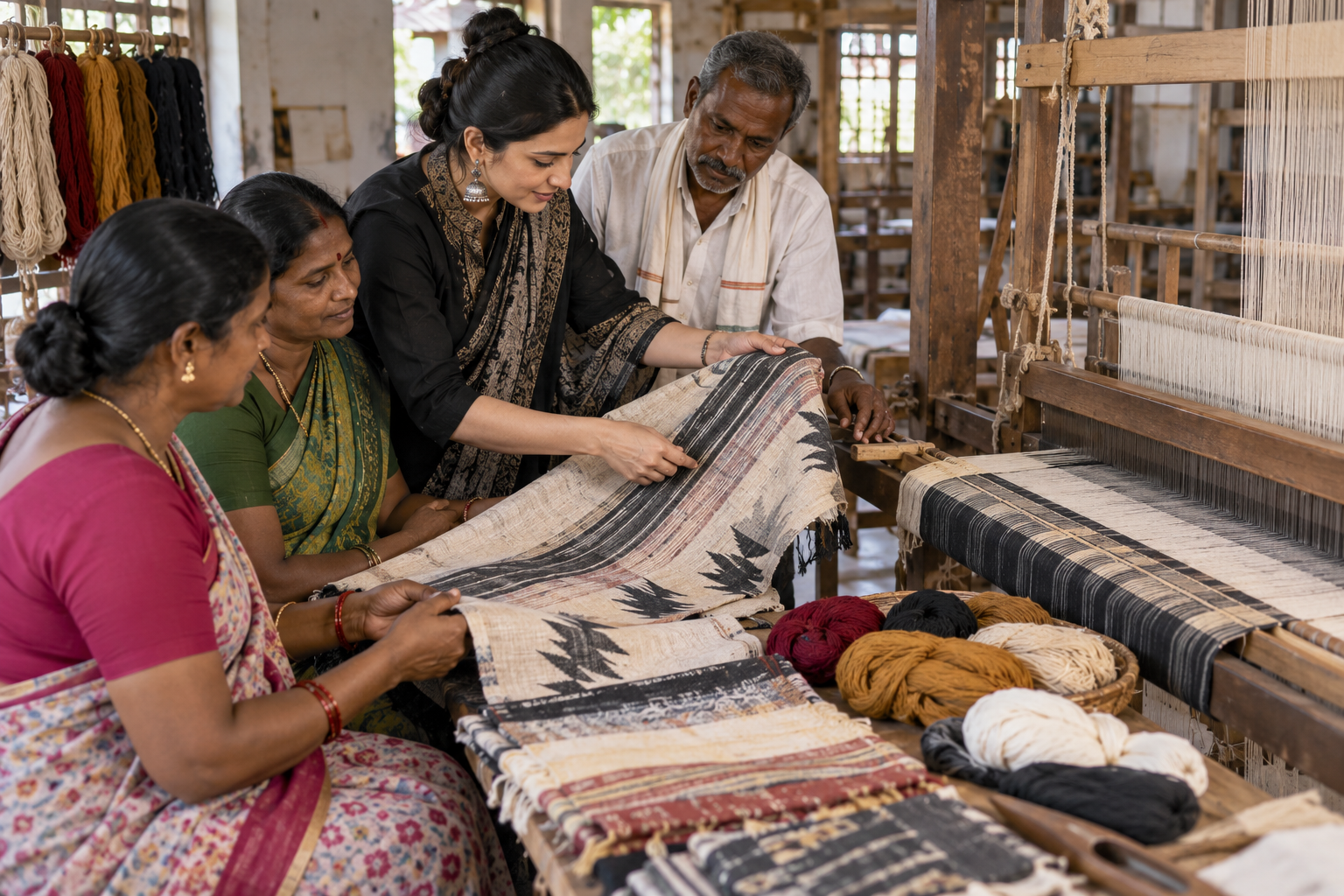
Working with Indian handloom and craft communities is not simply a matter of selecting an attractive textile and turning it into a fashionable garment. It is a multidisciplinary fashion-industry process involving cultural research, materials knowledge, design development, artisan relationships, sampling, production planning, costing, quality control, merchandising, communication and market access. Done well, it can create contemporary products without reducing a living craft tradition to surface decoration.
This distinction matters for anyone entering fashion. A handwoven textile or handcrafted surface may originate in a household, self-help group, weaving cluster, cooperative, artisan enterprise or specialist workshop whose production rhythms differ substantially from an industrial mill or garment factory. The designer therefore works inside a network rather than at the top of a one-way supply chain. Weavers and craftspeople hold technical knowledge about yarns, looms, motifs, tools, processes and local production conditions; designers and product teams may contribute silhouette development, colour planning, sizing, market research, merchandising and distribution. Commercial success depends on connecting those forms of expertise.
Recent industry initiatives make that workflow particularly visible. The Ministry of Textiles-backed Designer Atelier exhibition at Central Cottage Industries Emporium in New Delhi, held from 12 September to 1 October 2026, deliberately brought handloom weaves, traditional techniques and prints together with contemporary silhouettes and designer collections. Meanwhile, the 2026 Vogue India x Royal Enfield Himalayan Knot Design Prize asks applicants to develop community-oriented fashion proposals that address design, production, commercial viability, skills, sustainable sourcing and socio-economic benefit. For learners, these are useful reminders that craft-based fashion is simultaneously a design practice, production system, cultural relationship and business problem.
What "craft to market" means in Indian fashion
In fashion, "craft to market" describes the chain through which an existing handloom or handicraft practice becomes part of a product that can be produced, priced, presented, sold and potentially reordered. It should not imply that a designer "discovers" or creates the craft. Most Indian craft traditions already possess established techniques, aesthetics, social meanings, specialist vocabulary and markets of their own.
Handloom specifically concerns fabric woven on a loom operated manually rather than by power. Handicraft is broader and may include embroidery, printing, dyeing, appliqué, knitting, basketry, leatherwork, metalwork and numerous other skilled manual processes. A fashion collection can combine several systems: for example, handwoven cloth may later be hand-dyed, embroidered, cut and stitched into apparel.
The important professional distinction is between craft continuity and design intervention. Continuity preserves skills, processes and cultural knowledge already present in a community. Intervention introduces some new requirement: a colour palette, motif scale, fabric width, product category, pattern, finishing method or price point. Neither is automatically superior. The question is whether the intervention respects technical reality, recognises authorship and knowledge, creates viable work and produces something the intended customer actually wants.
The industry map: who connects community practice to fashion retail
Craft-based fashion rarely moves directly from one artisan to one designer to one customer. The working ecosystem can include individual master artisans, household producers, self-help groups, cooperatives, producer companies, NGOs, craft organisations, yarn and dye suppliers, designers, sampling teams, pattern cutters, tailors, quality controllers, merchandisers, photographers, retailers, marketplaces and government institutions.
| Part of the system | Typical contribution |
|---|---|
| Artisans, weavers and community enterprises | Technique, material knowledge, production, cultural context and craft-specific quality judgement |
| Design and product teams | Research, range planning, colour, silhouette, product development, technical specifications and sampling |
| Production and sourcing teams | Capacity planning, raw materials, timelines, costing, quality assurance and logistics |
| Merchandising and retail | Assortment, price architecture, quantities, presentation, inventory and consumer feedback |
| Institutions and intermediaries | Training, cluster support, exhibitions, documentation, market linkage, certification or marketplace access |
Understanding these connections is useful for students because craft-focused careers exist well beyond fashion design. Someone may enter through textile design, sourcing, product development, merchandising, craft research, communication, entrepreneurship, retail, social-impact programmes or production management.
From field research to a viable product brief
A responsible project usually starts with research before sketching. The team needs to understand what the community actually makes, which materials and tools are used, which steps require specialist skill, normal production dimensions, seasonal constraints, existing customers, capacity and the meaning of motifs or forms that might be culturally specific.
NIFT's Craft Cluster Initiative formalises this kind of learning through craft research and documentation, field engagement, design projects, demonstrations and bazaars. Its model is instructive even outside formal education: observe first, document accurately, understand the production system, then identify an intervention worth testing.
The next step is a product brief. Instead of saying "modernise this craft", a useful brief defines an intended user, product category, target selling range, material constraints, expected quantities, delivery window and design problem. A fashion label might explore a handwoven textile for jackets, for example, but first must determine whether its width, drape, weight, repeat size and production rate suit the proposed construction.
This is where romantic ideas frequently meet technical reality. A motif that looks effective on a full sari may not scale naturally onto a pocket panel. A labour-intensive surface technique may support a limited-edition product but be unsuitable for a low retail price. Good product development adapts the commercial proposition to the craft rather than assuming the craft must adapt indefinitely to the market.
Co-design, sampling and product development
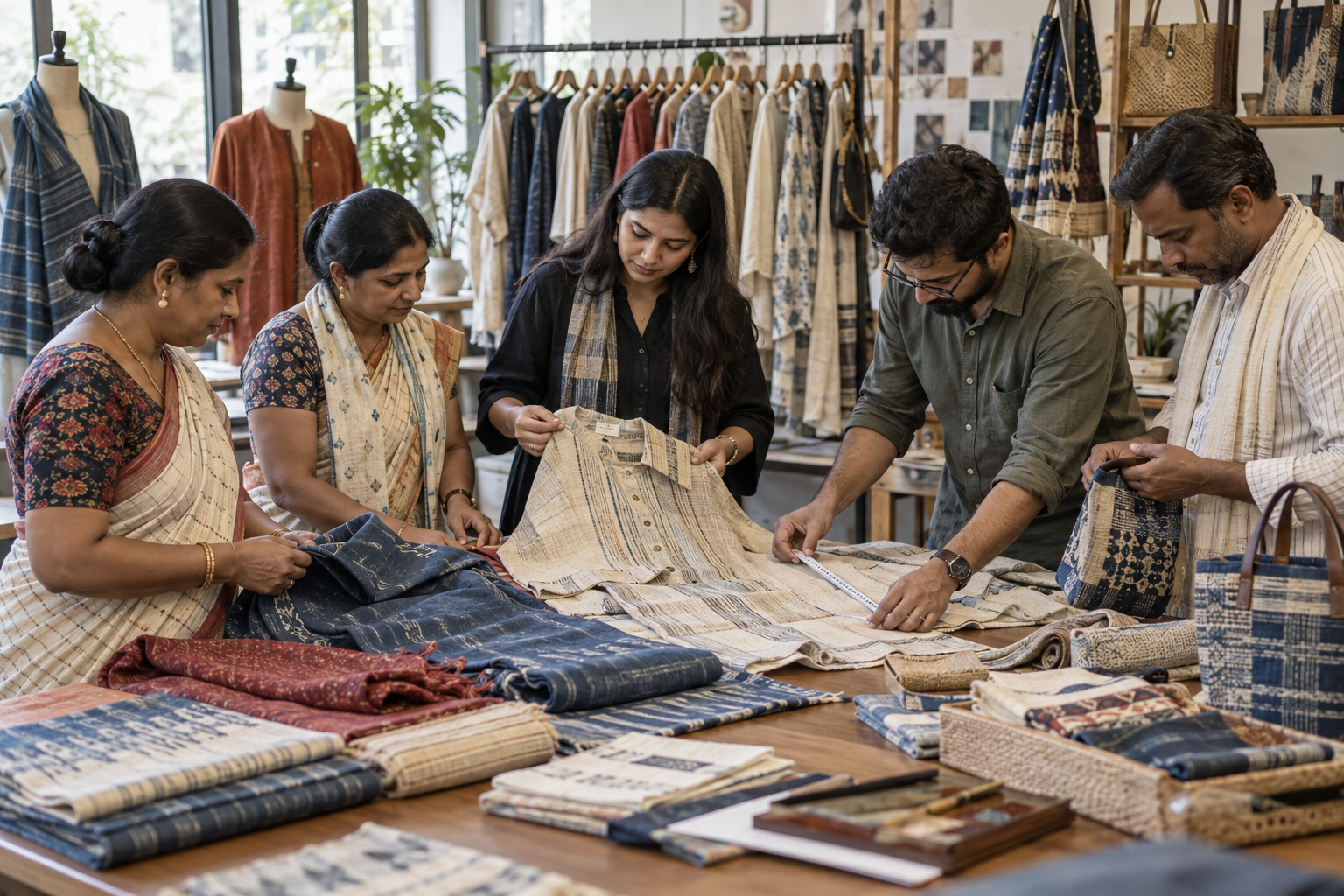
Co-design means that design decisions emerge through exchange between people with different expertise rather than being imposed through finished drawings. A designer might propose a colour arrangement while a weaver explains what is possible within the loom setup; an artisan may suggest a motif construction that achieves the visual effect more efficiently; a pattern cutter may then adjust the garment so important woven areas are not lost in seams.
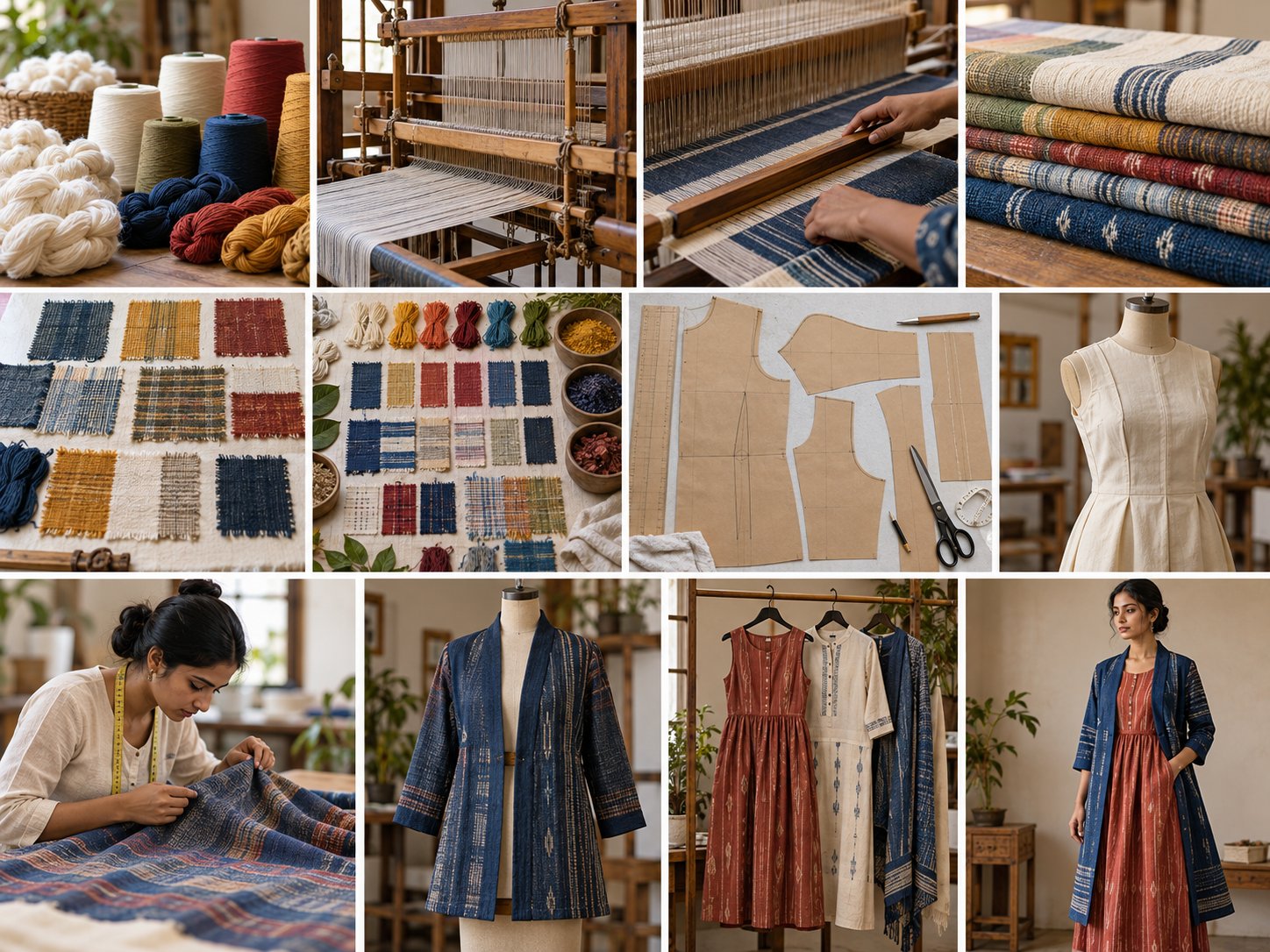
Sampling turns those discussions into evidence. Development may move through yarn or colour trials, woven or embroidered swatches, fabric lengths, first prototypes, fit samples and pre-production samples. Each round should capture information that can be repeated: dimensions, materials, motif placement, yarn specifications, stitch or weave characteristics, finishing, tolerances and time requirements.
The 2026 Himalayan Knot Design Prize illustrates how substantial this responsibility can become. Its published scope for the winning designer calls for a textile-oriented capsule collection, sampling and production, quality control, a business plan, market linkage and technical outputs including fabric samples, patterns and tech packs that the identified organisation or community can use for later production.
For a fashion professional, the lesson is important: craft collaboration does not end when a beautiful prototype exists. A commercially useful design must be teachable, reproducible within agreed variation, costable and capable of moving through production without depending permanently on the designer standing beside every maker.
Production, costing and quality without industrialising away the craft
Hand production contains variation. That does not mean quality is irrelevant; it means quality standards must distinguish acceptable handmade variation from actual defects. Shade variation, irregular texture or minor differences in placement may sometimes be inherent to a process, while broken yarns, unstable colour, incorrect measurements, weak seams or damage may be genuine quality failures.
Costing should begin with the real production system. Relevant components can include raw material, preparatory work, artisan labour, sampling, wastage, finishing, tailoring, packaging, transport, design and management costs, retailer margin, taxes and marketing. Compressing the artisan payment because the final retail price feels too high is not a sustainable costing strategy. Product, channel or margin assumptions may need redesign instead.
Capacity is equally important. A community that can reliably supply 40 units per month should not receive an order for 400 based on an industrial lead-time assumption. Production calendars need to account for material procurement, loom preparation, drying or dyeing conditions where relevant, agricultural seasons, festivals, household responsibilities and other work already accepted by producers.
This is one reason small capsules and staged orders are useful early in a relationship. They reveal actual throughput, rejection rates, communication gaps and customer response before either party makes promises that the production network cannot sustain.
Authenticity, attribution and cultural responsibility
Authenticity is more demanding than using words such as "heritage", "artisan-made" or "handcrafted" in marketing. Product claims should accurately describe what was made, where and by whom, and should not imply that every stage is handmade when only one component is. The Development Commissioner for Handlooms also maintains mechanisms and links relating to Handloom Mark and India Handloom Brand, reflecting the wider need to distinguish authentic handloom products and, in the case of India Handloom Brand, defined quality requirements.
Attribution should move beyond treating communities as anonymous labour. Where practical and agreed, communication can identify the craft, region, organisation or producer group and explain the collaboration accurately. Sensitive cultural knowledge requires additional care: not every ceremonial, religious or community-specific motif should automatically become a commercial graphic.
Intellectual-property arrangements also deserve explicit discussion before development begins. Questions include who owns newly developed designs, whether the community can reproduce them independently, whether a brand receives exclusivity, how long that exclusivity lasts and how images or community stories may be used.
The Himalayan Knot's 2026 published terms are unusually instructive because the programme expressly addresses community benefit and collection rights. Its scope states that rights in the capsule collection are to rest with the identified community, enabling future production. That is one programme's contractual model rather than a universal rule, but it demonstrates how ownership can be designed into a collaboration rather than left ambiguous.
Merchandising and the final move into the market
Merchandising translates a collection into a sellable assortment. A strong craft story cannot compensate for an incoherent range. Buyers still need products with understandable functions, sizes, prices, colour choices, delivery expectations and relationships to one another.
A merchandiser may decide which highly worked pieces should serve as visual anchors, which simpler products provide accessible entry prices, how many sizes or colourways are feasible and which items can be replenished. Retail teams then have to explain handmade variation without presenting it as poor consistency. Packaging, photography and product copy should convey provenance while giving practical information about material, dimensions, care and use.
Market access can take several forms: a designer's own store, multi-brand retail, exhibitions, museums or cultural shops, craft bazaars, institutional emporia, wholesale accounts and e-commerce. The Ministry of Textiles' Indiahandmade marketplace, for example, provides a seller route for eligible artisans, weavers and other enterprises, while CCIC offers another institutional retail context.
The recent Designer Atelier exhibition at CCIC is a useful fashion-industry case because its stated purpose was not simply preservation. It put authentic handloom and handwoven products into a consumer-facing environment alongside contemporary designer interpretations during the festive and wedding retail period. That connection between heritage, product design and purchasing behaviour is precisely where merchandising enters the craft conversation.
Role families and skills for careers in craft-based fashion
Craft collaboration requires professionals who can cross disciplinary boundaries. The most visible role may be designer, but the ecosystem needs several role families.
- Design and textile development: textile designers, fashion designers, surface designers, colour specialists and product developers.
- Research and documentation: craft researchers, design researchers, archivists, material researchers and cultural-documentation specialists.
- Sourcing and production: sourcing managers, cluster coordinators, production merchandisers, quality professionals and supply-chain managers.
- Commercial roles: buyers, retail merchandisers, category managers, e-commerce specialists and craft entrepreneurs.
- Communication: photographers, stylists, writers, brand strategists and fashion communicators who can represent provenance accurately.
- Development and institutional work: programme managers, trainers, NGO professionals, government-project staff and social-enterprise teams.
Across these roles, useful skills include fibre and fabric identification, colour and material judgement, basic costing, specification writing, spreadsheet competence, sampling management, field interviewing, documentation, negotiation, production planning and ethical communication. Language ability and cultural sensitivity can matter as much as software competence when working in clusters.
The best preparation combines technical education with direct observation. Someone who understands garment construction but has never watched a loom being prepared will miss constraints visible immediately to a weaver. Conversely, field knowledge becomes more commercially powerful when paired with merchandising, costing and product-development skills.
Organisations, programmes and events worth studying
National Institute of Fashion Technology (NIFT) provides one of the clearest educational models through its Craft Cluster Initiative. Students engage in field research, documentation, design innovation, product development and market-related activities with craft communities.
Development Commissioner for Handlooms, Ministry of Textiles is central to India's institutional handloom ecosystem and maintains information on clusters, marketing initiatives, Weavers' Service Centres, Handloom Mark, India Handloom Brand and related programmes.
Central Cottage Industries Corporation (CCIC) operates the Central Cottage Industries Emporium and provides an established retail and exhibition channel for Indian handicrafts and handloom. Its September-October 2026 Designer Atelier exhibition explicitly connected traditional craftsmanship with contemporary design.
Indiahandmade is a Ministry of Textiles initiative designed as an online marketplace supporting Indian craftspeople. Its seller onboarding demonstrates the administrative side of market access, including identity, banking and tax-related prerequisites.
The Himalayan Knot Design Prize, organised by Vogue India with Royal Enfield/Eicher Group Foundation, is especially relevant in 2026. Designer applications are listed as open from 25 September to 10 November 2026. The designer route requires prior ready-to-wear collections and asks applicants to address community impact, sustainable fashion, business planning and commercial viability; the student route provides a separate pathway for eligible final-year students and recent graduates.
Routes in and a practical learning path
For a student, entering this field does not require launching a craft label immediately. A safer learning path is to develop competence in stages.
- Learn materials and construction. Study fibres, yarns, woven structures, surface techniques, garment construction and finishing so that visual ideas can be discussed technically.
- Document one craft carefully. Research terminology, process sequence, materials, tools, existing products, producer organisation and current markets. Separate observed evidence from assumptions.
- Build a small design exercise. Create swatches or one product family rather than an oversized collection. Record specifications and revisions.
- Learn costing and merchandising. Calculate the complete product cost and compare plausible wholesale, direct-to-consumer and retail structures.
- Gain field or organisational experience. Craft-cluster projects, internships, graduation projects, NGOs, designer studios, sourcing teams, exhibitions and institutional programmes can reveal how production works beyond the classroom.
- Create a professional portfolio. Show research, collaboration, failed trials, final samples, technical reasoning and commercial decisions rather than only polished photographs.
Working professionals can enter from adjacent functions as well. A merchandiser can specialise in artisan supply chains, a textile designer can develop cluster-based materials, and a communications professional can focus on provenance and responsible storytelling. The opportunity is not one job title but an interconnected sector requiring people who can translate between making, design and markets.
Opportunities, trade-offs and the future of craft-based fashion
Indian handloom and craft offer fashion something industrial standardisation cannot easily reproduce: regionally embedded skills, complex manual processes, material character and the possibility of meaningful differentiation. They can support premium products, limited editions, accessories, contemporary apparel, home-related fashion categories and direct-to-consumer enterprises.
Yet craft is not automatically sustainable, ethical or economically fair simply because it is handmade. Raw materials may still have environmental impacts; dyeing and finishing require scrutiny; long transport networks can add cost; poorly planned orders can create waste; and a high retail price does not prove that producers received an equitable return. Responsible commercialisation therefore requires evidence about the actual supply chain rather than relying on the moral appeal of handmade production.
Digital marketplaces, improved documentation, better inventory systems and technical specifications can increase market access without demanding that every producer become an urban fashion entrepreneur. At the same time, digital visibility creates pressure for faster copying and oversimplified storytelling. The valuable future direction is therefore not indiscriminate "modernisation" but stronger partnerships in which technical craft knowledge, design capability, ownership, production discipline and market intelligence reinforce one another.
Building a fashion career where craft knowledge meets market knowledge
The journey from Indian craft to contemporary fashion is best understood as a sequence of translations. Community knowledge becomes a documented material and process system; that system enters a design brief; prototypes test what the technique can realistically produce; costing and production planning establish whether the idea can survive beyond a sample; merchandising gives the range commercial structure; and retail connects the finished work with customers. Every translation can add value, but every translation can also distort what came before it.
For learners, this makes craft-based fashion an unusually rich professional classroom. It demands textile literacy, design judgement and sensitivity to culture, while also exposing the practical mechanics of specifications, capacity, pricing, quality, logistics, retail and communication. Programmes such as NIFT's Craft Cluster Initiative provide structured exposure, while current opportunities such as the 2026 Himalayan Knot Design Prize demonstrate how community impact, product development and commercial thinking are increasingly being evaluated together.
The strongest future for craft in fashion is neither museum preservation nor superficial styling. It lies in commercial systems that allow living skills to evolve without stripping communities of agency, recognition or economic value. Designers who understand production, merchandisers who understand making, and craft organisations that gain stronger product and market capabilities can create relationships that endure beyond one collection. That ability to connect cultural knowledge with disciplined fashion-industry practice is what turns craft collaboration from an aesthetic theme into a serious professional field.